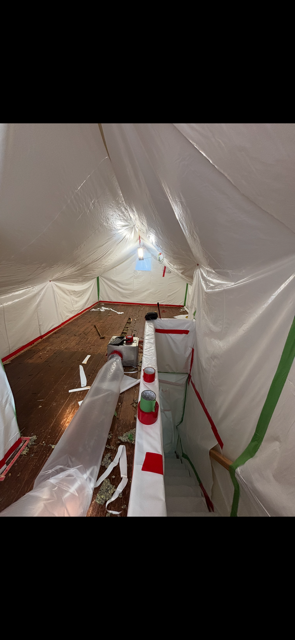
You need lead abatement — rather than interim controls — when children under 6 live in the home, when paint is deteriorating or on friction surfaces like windows and door frames, when renovation will disturb painted surfaces, or when Pennsylvania regulations or housing assistance program rules require permanent hazard elimination. Lead abatement is the permanent elimination of lead hazards from a building — through removal, enclosure, or encapsulation — as opposed to interim controls that reduce exposure while leaving the lead in place. Whether abatement is required, recommended, or simply the right choice depends on your specific situation, who lives in your home, what work is planned, and which regulations apply.
Here is how to think through those questions for a pre-1978 home in Delaware County or the Philadelphia area.
The Difference Between Interim Controls and Abatement
Interim controls are measures that reduce lead exposure without permanently eliminating the hazard: stabilizing peeling paint, cleaning dust with lead-specific cleaning methods, reducing friction on high-friction surfaces, and covering bare soil near the foundation. Interim controls are less expensive and less disruptive than abatement, and they are appropriate in many situations — particularly when the paint is stable, the occupants are not in high-risk categories, and no renovation is planned.
Abatement permanently eliminates the lead hazard through one of three methods:
- Removal: Stripping lead paint from surfaces, typically followed by repainting. Requires a licensed lead abatement contractor and generates lead dust that must be contained and disposed of properly.
- Enclosure: Covering lead-painted surfaces with new materials (drywall, paneling, flooring) that permanently seal the hazard beneath.
- Encapsulation: Applying a specially formulated encapsulant coating that bonds to lead paint and prevents dust generation. Appropriate only when the substrate is sound.
Abatement is required rather than optional in certain circumstances.
When Abatement Is Required
Before renovation work: The EPA’s Renovation, Repair and Painting (RRP) Rule requires that any contractor performing renovation that disturbs 6 or more square feet of painted interior surface (or 20 or more square feet of exterior) in a pre-1978 residential building be an EPA-certified Lead-Safe Certified Firm. Renovation activity in pre-1978 homes must be performed using lead-safe work practices — not because the lead paint must be removed, but because the renovation must not create a new lead hazard.
However, when renovation will disturb substantial amounts of lead paint — a kitchen renovation, window replacement, floor replacement — the combination of renovation dust and normal renovation activity can mobilize significant lead. Many contractors and environmental consultants recommend completing targeted lead abatement before the renovation begins, rather than trying to manage lead exposure while other work is ongoing.
For certain housing assistance programs: Federal and state housing assistance programs for pre-1978 housing — including housing choice vouchers, HOME program funds, and certain state rehabilitation programs in Pennsylvania — have lead hazard reduction requirements. Depending on the program, the assistance amount, and the property condition, abatement may be required as a condition of funding.
After a child tests positive for elevated blood lead: Under Pennsylvania Department of Health guidelines, when a child under 6 has a confirmed elevated blood lead level, the Department works with the family to identify the source. When the source is identified as the home, the property owner may be required to remediate the hazard — particularly for rental properties.
Why Lead Abatement Makes Sense Even When Not Required
Interim controls are appropriate for stable paint that is not being disturbed. But there are situations where abatement makes practical sense even when not legally required:
You have young children or are expecting. The CDC states there is no safe blood lead level in children. Young children’s hand-to-mouth behavior and their developing nervous systems make them uniquely vulnerable. Permanently eliminating the hazard rather than managing it indefinitely is the lower-risk choice for families with children under 6.
You are planning future renovations. Any future renovation that disturbs painted surfaces in a pre-1978 home creates a lead hazard management challenge. Completing targeted lead abatement on surfaces that will be disturbed by planned future projects — before those projects begin — simplifies the renovation process and reduces risk.
You are buying or selling. Federal law (the Residential Lead-Based Paint Hazard Reduction Act) requires sellers of pre-1978 homes to disclose known lead hazards and provide buyers with the EPA pamphlet “Protect Your Family from Lead in Your Home.” Buyers have the right to a 10-day inspection period for lead-based paint. A home with documented lead abatement and a clean clearance inspection is a more defensible asset than one with undocumented lead hazards.
You own rental property. Pennsylvania has specific requirements for rental properties in pre-1978 housing regarding lead hazard disclosure and, in some jurisdictions including Philadelphia, mandatory lead hazard inspections. Rental property owners should consult current Philadelphia and Pennsylvania requirements, which have changed in recent years.
The Abatement Process
A compliant lead abatement project requires:
- A lead risk assessment or lead paint inspection to identify and characterize hazards
- An abatement plan developed by a certified lead abatement supervisor
- Work performed by a certified lead abatement contractor and workers, using containment, wet methods, and HEPA equipment
- Clearance examination after the work is complete — visual inspection plus dust wipe sampling — performed by a certified lead inspector or risk assessor (not the contractor who did the work)
- A clearance report documenting that the work met the applicable standards
In Pennsylvania, lead abatement contractors must hold EPA certification as lead-safe renovation firms and have appropriately certified personnel on site. Pennsylvania also has its own lead certification requirements that apply to contractors working under certain state and federal housing program funding.
ACI-TECH, INC. provides lead risk assessments and lead remediation services in Chester, Delaware County, and the Philadelphia area. Call (610) 497-7162 for a free estimate.