Choosing an asbestos abatement contractor is not like hiring a painter or a plumber. The consequences of poor work are not visible immediately — they may not show up for decades, in the form of a mesothelioma diagnosis or lung cancer. And unlike most trades, asbestos work in Pennsylvania requires specific state certifications that are publicly verifiable. You do not have to take a contractor’s word for it.
Here is what to confirm before hiring anyone for asbestos work in your home.
Verify Pennsylvania Certification — Do Not Just Ask
In Pennsylvania, performing asbestos abatement work without the required certification is illegal. The Pennsylvania Department of Labor & Industry issues separate certifications for:
- Asbestos Inspector — performs visual assessments and collects bulk samples
- Asbestos Abatement Contractor — the company license required to perform removal work
- Asbestos Abatement Supervisor — the on-site supervisor for abatement crews
- Asbestos Abatement Worker — workers performing hands-on removal
Ask any contractor for their PA L&I certification numbers and verify them through the PA L&I licensing verification system. Certifications can lapse and must be renewed. A contractor who is reluctant to provide certification numbers is not a contractor you should hire.
Also ask whether the company is an EPA-certified Lead-Safe Certified Firm under the EPA’s Renovation, Repair and Painting (RRP) Rule. In most pre-1980 homes, asbestos and lead paint coexist, and the abatement contractor may be working in close proximity to lead-painted surfaces.
Understand What “Inspection” vs. “Abatement” Means
A legitimate asbestos process begins with inspection, not abatement. Before any material is removed, a certified asbestos inspector should:
- Conduct a visual assessment of the property
- Identify suspect materials
- Collect bulk samples and have them analyzed by an accredited laboratory
- Provide a written report documenting what was found and in what condition
Abatement work — actual removal — should not begin until inspection and lab results confirm what is present. Be skeptical of any contractor who wants to begin removal without documented testing first.
The separation of inspection and abatement is not just best practice — it is also a protection against conflicts of interest. An inspector who also does the abatement work has an incentive to find more asbestos than is actually present. In Pennsylvania, the same individual can hold both inspector and abatement certifications, but knowing whether your contractor distinguishes the roles in practice is a fair question.
Ask About the Specific Process
A credible abatement contractor should be able to describe their process clearly:
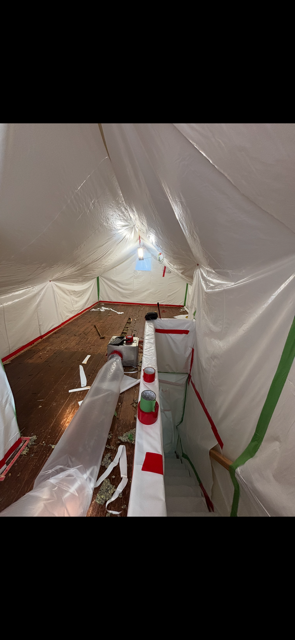
- How will the work area be contained? (Negative-pressure containment with HEPA exhaust units is standard for friable material.)
- What respiratory protection will workers use?
- How will wet methods be used to control fiber release during removal?
- How will air quality be monitored during and after the work?
- Who performs the post-abatement air clearance testing? (This should be an independent industrial hygienist, not the contractor performing the work — though in some smaller projects, the same firm may handle both.)
- How will waste be packaged, labeled, and disposed of?
A contractor who cannot answer these questions clearly has not been trained in proper abatement procedure.
Post-Abatement Air Clearance Testing
Post-abatement air clearance testing is the quality control step that confirms removal was done correctly. After the work is complete and the area has been cleaned, an air sample is collected and analyzed. The project is not considered complete until the clearance sample passes — fiber counts below the applicable threshold.
Ask whether clearance testing is included in the scope of work, who performs it, and what happens if clearance fails. Reputable contractors stand behind their work and will remediate until clearance passes.
Questions About Cost and Realistic Expectations
Asbestos abatement is a regulated process that requires certified workers, specialized equipment (HEPA vacuums, containment materials, respirators), compliant waste disposal, and documentation. It has a real cost floor.
A quote that seems dramatically low compared to others is worth scrutinizing: either the scope does not include post-abatement air clearance, disposal is not included, corners are being cut on containment, or the contractor is not properly certified. Getting at least two quotes from PA-certified contractors and asking each for a line-item breakdown of what is included helps you compare accurately.
The Practical Checklist Before You Hire
Before signing any agreement with an asbestos abatement contractor in Delaware County or the Philadelphia area:
- Verified current PA L&I certification for the company (contractor license) and supervisor
- Verified EPA RRP certification if lead paint may be encountered
- Inspection report with lab-confirmed results before abatement begins
- Written scope of work describing containment, wet methods, PPE, and waste disposal
- Post-abatement air clearance testing included and performed by qualified party
- Written documentation provided at project completion
ACI-TECH, INC. holds the required PA certifications for asbestos inspection and abatement and serves Chester, Delaware County, and the Philadelphia area. We begin every project with licensed testing before any removal work proceeds. Call (610) 497-7162 for a free estimate.