Asbestos is one of the most misunderstood substances a homeowner can encounter. Here are straightforward answers to the questions we hear most often.
What is asbestos?
Asbestos is a group of six naturally occurring silicate minerals that form in long, thin fibers. The six types recognized by the EPA are chrysotile (the most common, also called white asbestos), amosite (brown), crocidolite (blue), and three amphibole varieties — tremolite, anthophyllite, and actinolite.
All six types are classified as Group 1 human carcinogens by the International Agency for Research on Cancer. The United States has not comprehensively banned asbestos — new uses are heavily restricted, but some existing applications continue, and the material remains in place in millions of pre-1980 buildings.
Why was asbestos used so widely in construction?
Asbestos had a combination of properties that made it extraordinarily useful in building materials: high tensile strength, resistance to heat and fire, resistance to chemical attack, electrical insulation, and acoustic dampening. It could be mixed with cement, vinyl, and other materials to produce durable, inexpensive composite products. It was inexpensive and abundant.
From roughly the 1930s through the late 1970s, asbestos was incorporated into insulation, floor tiles, ceiling tiles, roofing shingles, siding, pipe wrap, joint compound, and many other products. Its health effects were documented as early as the 1930s but were suppressed by industry interests and did not lead to significant regulatory action until the 1970s and 1980s.
When does asbestos become dangerous?
Asbestos-containing materials are generally not an immediate hazard when they are intact, undisturbed, and in good condition. The danger arises when fibers become airborne — which happens when materials are cut, sanded, drilled, scraped, broken, or allowed to deteriorate to the point where they crumble.
Inhaled asbestos fibers cannot be expelled by the body. They lodge in lung tissue and remain permanently. Accumulated fibers cause asbestosis (progressive lung scarring), pleural disease, lung cancer, and mesothelioma. These diseases have latency periods of 10 to 50 years — meaning exposure today may not produce symptoms for decades.
The EPA and OSHA both operate on the principle that no safe level of asbestos exposure has been established, and that reducing exposure to as close to zero as possible is the correct approach.
What products still contain asbestos today?
Asbestos in new products is heavily restricted in the United States but not fully banned. The EPA’s 2024 rule under the Toxic Substances Control Act (TSCA) significantly tightened restrictions on chrysotile asbestos, phasing out most ongoing uses. However, the larger practical concern for homeowners is not new products — it is the asbestos already in place in pre-1980 homes and buildings.
How do I know if my home has asbestos?
You cannot know by looking. Asbestos-containing materials are visually identical to non-asbestos materials of the same type. The only way to confirm the presence of asbestos is laboratory analysis of a bulk sample.
If your home was built before 1980, common locations to check include:
- 9×9 inch vinyl floor tiles and the black adhesive beneath them
- Pipe insulation in the basement and utility areas
- Spray-on textured ceiling finishes
- Drywall joint compound
- Roofing and siding shingles
- Boiler and furnace insulation
What should I do if I think I have asbestos?
Do not disturb the suspected material. Contact a PA-certified asbestos inspector to assess your home and collect samples. Do not rely on DIY test kits, which require disturbing the material yourself and provide less reliable results than professional bulk sampling.
If testing confirms asbestos, a licensed inspector can advise whether the material needs abatement (removal) or can safely remain in place with monitoring. Abatement is required before any renovation work that will disturb the material.
Is it safe to stay in my home if asbestos is present?
In most cases, yes — if the asbestos-containing material is intact, in good condition, and not being disturbed. Intact non-friable floor tiles or roofing shingles do not present an active hazard in normal use. Deteriorating pipe insulation or damaged ceiling tiles with visible crumbling do warrant prompt professional attention.
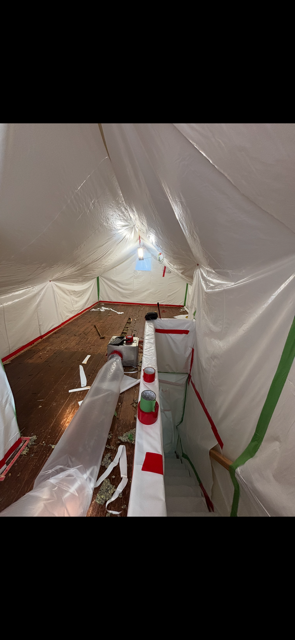
The decision to stay or temporarily relocate during abatement work depends on the scope of the project and your contractor’s recommendations. A licensed abatement contractor will establish containment and air monitoring to protect occupants.
ACI-TECH, INC. provides licensed asbestos inspection and testing for homes and commercial properties in Chester, Delaware County, and the Philadelphia area. If testing confirms asbestos and removal is needed, we provide licensed abatement with proper containment and disposal. Call (610) 497-7162 for a free estimate.