Licensed asbestos removal in Chester County, PA starts with testing — confirming what materials you have and whether they contain asbestos — before any demolition, renovation, or mechanical work disturbs them. Chester County’s pre-1980 housing stock, spread across Victorian boroughs like West Chester and Phoenixville, early 20th-century worker housing in Coatesville, and postwar ranches and splits throughout the townships, contains a range of asbestos-containing materials in predictable places. Here is what removal involves and what PA regulations require.
What Asbestos Materials Are Most Common in Chester County Homes
Chester County’s pre-war boroughs and postwar suburban townships have distinct asbestos profiles that reflect their construction eras.
West Chester, Phoenixville, Coatesville, Downingtown — pre-1940 homes:
The Victorian and early 20th-century housing stock in Chester County’s older boroughs was heated by steam. Original steam distribution pipe insulation — from the boiler takeoffs through the basement runs and sometimes up into wall chases — was asbestos in almost every installation before the mid-1930s. After 70 or more years, the insulation is often intact on the straight horizontal runs but cracking and friable at the elbows and joints, where the material expands and contracts through decades of heating cycles. If your older Chester County home has original steam heat that has never been updated, those pipe systems should be sampled before any mechanical work in the basement.
Asbestos-cement (transite) siding and roofing materials appear on homes from the 1920s through the 1950s, often applied as an exterior renovation layer over original wood clapboard. Asbestos-reinforced plaster in mid-century renovations is a less common but real finding in pre-war Chester County homes.
Township homes from 1945–1980 — the postwar asbestos set:
9×9 vinyl floor tiles and the black mastic adhesive beneath them are the most common confirmed asbestos finding in mid-century Chester County homes. Tiles manufactured before the early 1980s typically contain chrysotile asbestos at around 3–25% by weight. Any kitchen, bathroom, or finished basement floor in a home from this era should be sampled before renovation.
Attic vermiculite insulation — the gray-brown granular loose-fill product marketed under the Zonolite brand — appears in homes that received insulation upgrades from the 1950s through the 1980s. The EPA documents that most pre-1990 vermiculite in the US came from a Libby, Montana mine contaminated with tremolite asbestos. Treat untested loose-fill granular attic insulation as asbestos-containing until sampled.
Asbestos duct tape on forced-air heating connections, joint compound in drywall renovations from before 1977, and spray-applied acoustic ceiling texture from before 1973 round out the postwar material set. The EPA restricted spray-applied asbestos products in 1973 and asbestos-containing patching compounds in 1977.
Asbestos Testing Before Removal: The Required First Step
No removal project begins without confirmed testing. A PA-certified asbestos inspector collects bulk samples from suspect materials — tile, pipe insulation, plaster, attic insulation — and sends them to an NVLAP-accredited laboratory for analysis. Results are typically available in two to three business days.
Testing confirms: (1) whether asbestos is present, (2) the fiber type, and (3) the concentration. All three affect how the removal is classified and what regulatory requirements apply.
A positive result on a Chester County pre-war home is not a crisis — it is information. Intact, undisturbed asbestos-containing materials that are not being renovated are not an active exposure risk. The hazard is disturbing them without knowing they are there. Testing before renovation prevents that.
What Asbestos Removal Involves: Containment, Removal, Air Clearance
Proper asbestos abatement follows a consistent sequence regardless of material type.
Containment. Before any asbestos is disturbed, the work area is sealed with poly sheeting and placed under negative pressure using a HEPA-filtered air unit. The decontamination airlock — a double-entry transition zone separating the work area from the rest of the building — ensures crew and equipment entering and exiting do not carry fiber into the living space.
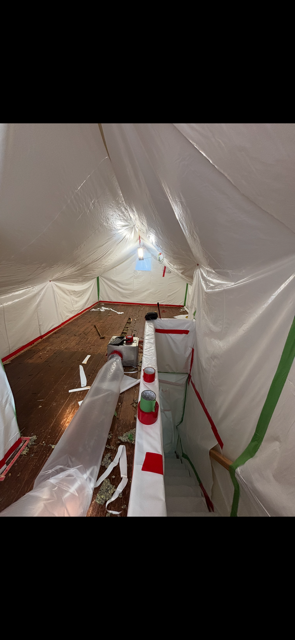
Removal. Wet methods suppress fiber release during removal — dry scraping or grinding asbestos-containing materials is not an acceptable practice. All removed material goes into sealed, labeled 6-mil poly bags inside containment. No asbestos waste travels through unprotected parts of the home.
HEPA cleanup. After removal, all surfaces are HEPA-vacuumed. Standard shop vacuums recirculate fine asbestos fibers; only HEPA-filtered units capture particles at the size relevant to asbestos.
Regulated disposal. Asbestos waste is classified as regulated material under Pennsylvania law and must be transported to and disposed of at a PA DEP-permitted facility. ACI-TECH provides waste manifests documenting the full chain of custody from the work site to the disposal facility.
Air clearance testing. A third-party inspector collects post-abatement air samples to confirm fiber concentrations are below EPA clearance standards. The work area is not released for occupancy until the clearance certificate is issued.
Pennsylvania Regulations for Asbestos Removal in Chester County
Chester County asbestos removal falls under two overlapping regulatory frameworks:
PA Department of Labor & Industry certification requirements apply to contractors performing asbestos abatement. Any contractor removing friable asbestos above the minimum thresholds must hold PA L&I certification. Projects above 260 linear feet, 160 square feet, or 35 cubic feet of regulated asbestos-containing material require a 10-working-day advance notification to PA DEP under the federal NESHAP framework.
EPA NESHAP (National Emission Standards for Hazardous Air Pollutants) governs larger renovation and demolition projects and sets the federal notification and work practice requirements that PA DEP enforces for Chester County.
Pennsylvania also has a private residence exemption that allows homeowners to remove asbestos from their own single-family home without PA DEP notification for projects below the NESHAP thresholds. However, proper respiratory protection, containment, wet methods, and licensed disposal are still required. DIY asbestos removal without that equipment creates an exposure event — licensed abatement exists because the technical requirements for safe removal are not achievable with standard renovation tools.
ACI-TECH holds PA Asbestos Contractor License C0238A and handles all required state and federal notifications as part of every project scope.
Chester County Homes ACI-TECH Regularly Works In
ACI-TECH is based in Chester, PA and serves all of Chester County. The housing stock we most regularly work in:
West Chester Victorian and Federal homes — 1840s through 1920s construction. Steam pipe insulation is near-universal in original mechanical systems. Plaster walls in mid-century renovations and exterior transite siding on additions from the 1930s–1950s are common secondary findings.
Coatesville worker housing — Early 20th-century homes built for Lukens Steel employees. Same pre-war risk profile as West Chester, often with 9×9 tile additions in mid-century kitchen and basement renovations. See our post on Lukens Steel and asbestos in Coatesville-area homes for the industrial context.
Phoenixville Phoenix Iron Company area — Pre-war row homes and twins with steam heat pipe systems and original plaster walls. Similar profile to Chester’s inner boroughs.
Township ranches and splits from the 1950s–1970s — 9×9 floor tiles and mastic, asbestos duct tape on forced-air systems, and attic vermiculite insulation in homes that received loose-fill upgrades before 1990.
Chesterbrook and planned communities from 1977–1985 — The borderline era. Some units from the later construction phases used asbestos-free materials as manufacturers phased out asbestos during the late 1970s, but units from the earlier construction phases may contain 9×9 tile, asbestos duct tape, and joint compound. Testing before renovation is the only way to confirm which side of the line a specific unit falls on.
Before Any Chester County Renovation: Get a Pre-Renovation Inspection
The practical step for any Chester County home built before 1980 is a pre-renovation inspection before the contractor starts work. A PA-certified inspector surveys the materials that will be disturbed — flooring, pipe insulation, plaster, ceiling texture, duct connections — collects bulk samples, and delivers a written report documenting what is present, in what condition, and what must be abated before renovation proceeds.
This documentation protects the homeowner, the renovation contractor, and the occupants. It is the difference between an informed renovation and an uncontrolled asbestos release.
ACI-TECH provides asbestos testing and pre-renovation inspections throughout Chester County, with lab results in two to three business days. If testing confirms asbestos, we schedule asbestos removal before the renovation contractor enters the work area. For a full overview of Chester County asbestos and lead paint risk by borough and township, see our Chester County asbestos guide.
Call (610) 497-7162 or contact us online for a free estimate — available seven days a week.
Sources