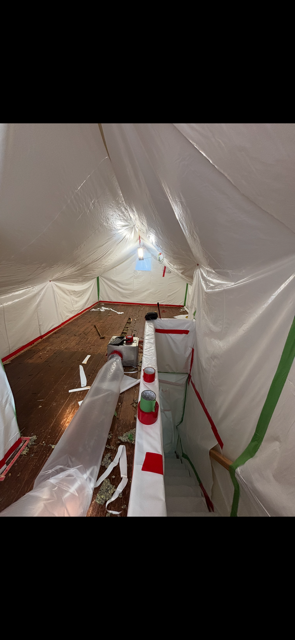
If you’re buying a pre-1980 home in Montgomery County, include an asbestos testing contingency in your purchase agreement — and if the property is in Ambler, add a deed restriction search to your standard due diligence. Montgomery County has two EPA Superfund sites associated with former asbestos manufacturing operations in Ambler Borough: the Ambler Asbestos Piles site and the BoRit site, both tied to Keasbey & Mattison Company, which operated an asbestos manufacturing plant in Ambler from 1881 until the mid-twentieth century. That history does not create indoor building-materials risk, but some Ambler properties carry deed restrictions or institutional controls that need to be identified before closing. For the rest of the county’s pre-war housing stock, the due diligence is the same as anywhere in the Delaware Valley — but the specific profile of Montgomery County’s older boroughs and the Main Line market shapes what you should prioritize.
Montgomery County’s Older Boroughs vs. the Main Line vs. Postwar Suburbs
Montgomery County is not a uniform market. Montgomery County’s older boroughs were built out in the late nineteenth and early twentieth centuries, and Census housing age data shows that pre-1960 housing represents a large majority of the housing stock in places like Norristown, Ambler, Conshohocken, and Pottstown. In the Main Line townships — Lower Merion, Cheltenham, Abington, and Narberth — a significant share of the housing stock was built between 1900 and 1945: Victorian singles, Craftsman bungalows, and stone colonials that have been extensively maintained and renovated over the past century.
The county also has large postwar suburban areas — communities built from the 1950s through the 1980s where pre-1978 construction is still possible but the specific older-borough risk profile does not apply. For buyers focused on the county’s older boroughs or the Main Line, the asbestos risk framework for Delaware County’s pre-war housing stock applies directly.
Pre-1980 properties in any of these areas — especially anything built before 1950 — fall within the primary asbestos risk window. The EPA restricted spray-applied asbestos in 1973, asbestos pipe insulation for residential use in 1975, and asbestos-containing patching compounds in 1977. A home built or renovated before any of these restrictions may contain any or all of these materials.
What a Pre-Purchase Inspection Covers in the Main Line and Older Borough Markets
The Main Line and older borough housing stock — stone colonials, Craftsman bungalows, Victorian singles — creates specific inspection dynamics. These homes have often been renovated multiple times over 80–120 years, which means layered construction: original steam-heat pipe insulation from the 1910s underneath forced-air ductwork added in the 1960s, original tile covered by a 1950s vinyl floor, original plaster refinished with mid-century joint compound. Each renovation era adds its own potential ACM.
A licensed general home inspector will flag suspect materials visually — deteriorating wrap on basement pipes, original floor tiles, aging ceiling texture. What a general inspector cannot do is collect bulk samples for laboratory confirmation or issue a formal PA-certified asbestos inspection report. For a Main Line stone colonial or a Norristown Victorian where the renovation history spans a century, a general inspection note recommending specialist follow-up is not unusual — it’s the standard written output on homes of this age and complexity.
A “no known asbestos” disclosure from a seller of a pre-war Cheltenham or Abington property does not mean no asbestos is present. Pennsylvania’s seller disclosure law requires sellers to disclose what they know — not to test before sale. Most sellers of pre-war properties have never had a formal inspection. Following up before the inspection contingency expires is how buyers protect themselves from post-closing discoveries.
The Asbestos Testing Contingency: How to Structure It for a Montco Transaction
The standard approach for a pre-1980 property in Montgomery County is an asbestos testing contingency in the purchase agreement — a defined window (typically 10 to 14 days) for a PA-certified asbestos inspector to survey the property and collect bulk samples from suspect materials.
In the Main Line market, where sale prices on pre-war properties frequently range into the high six or seven figures and renovation scopes can be substantial, documented asbestos information before closing is straightforward risk management. A confirmed positive finding gives you factual grounds to negotiate:
- Request abatement before closing (seller pays)
- Request a price reduction reflecting abatement costs
- Request a credit at closing
- Walk away within the contingency window
Experienced real estate attorneys and agents in Lower Merion, Cheltenham, and Abington routinely handle asbestos contingencies on pre-war properties. This is not an unusual request in this market.
Asbestos Materials to Prioritize by Construction Era in Montco’s Pre-War Housing
For a Victorian, Craftsman, or pre-war stone colonial in Montgomery County’s older boroughs or Main Line townships, the materials most commonly confirmed positive vary by construction era.
Pre-1940 homes — steam-heat profile:
- Pipe insulation on steam distribution lines (near-certain in original steam systems)
- Boiler insulation and duct wrap at the furnace
- Plaster walls that were refinished or textured in the mid-century
1940–1960 homes — mixed systems:
- 9×9 vinyl floor tiles and black mastic adhesive (kitchen, bathroom, finished basement)
- Sheet vinyl flooring — some backing and adhesive layers contain asbestos
- Joint compound on drywall in mid-century renovations
All pre-1980 homes:
- Attic vermiculite insulation — if present, treat as positive until tested; most pre-1990 vermiculite in the U.S. came from a contaminated Libby, Montana mine, per the EPA
- Exterior transite (asbestos-cement) siding on pre-1980 additions and garage structures
- Original roof shingles on pre-1980 structures
The Ambler Complication: Two EPA Superfund Sites
If you are buying in Ambler Borough specifically, there is a layer of due diligence beyond standard residential asbestos testing. The Ambler Asbestos Piles site and the BoRit site are both on the EPA National Priorities List. The contamination originated with Keasbey & Mattison Company, an asbestos manufacturing company that operated in Ambler for decades before the facilities were closed. W.R. Grace & Co. is also listed as a potentially responsible party for cleanup costs at the BoRit site.
The contamination is in soil and former industrial areas — not in the building materials of residential properties. But some parcels near the former industrial areas may carry deed restrictions, institutional controls, or other recorded environmental covenants related to the cleanup.
Before closing on a property in Ambler, verify through a full title search that no recorded environmental covenant applies to the specific parcel. If you find one, contact PA DEP Southeast Region at (484) 250-5920 for clarification — institutional controls at Superfund sites are typically tracked in the county deed index rather than disclosed voluntarily during a standard real estate transaction. Ambler Borough’s municipal offices can also point you toward any publicly recorded notices tied to specific blocks near the former Keasbey & Mattison footprint. Our post on the Ambler Superfund sites and what homeowners need to know covers this in detail.
Managing Confirmed Asbestos After You Close
If you purchase a Montgomery County pre-1980 property with known asbestos-containing materials that are intact and not being disturbed, immediate abatement is not always required. The practical framework:
- Abate before renovation. Any material that will be cut, removed, or disturbed must be addressed first. PA L&I regulations require contractor notification for projects involving friable asbestos.
- Abate deteriorating material. Pipe insulation that is actively crumbling releases fibers without any renovation activity. This is a health issue independent of renovation plans.
- Manage stable, intact material in place. Document it with a professional inspection report and revisit before any future project.
A pre-1980 Montgomery County home with asbestos-containing materials is not a problem property — it is a property with known conditions that can be managed professionally. The risk is not knowing before you renovate.
ACI-TECH, INC. serves buyers, sellers, and property owners throughout Montgomery County, including Norristown, Ambler, the Main Line townships, and surrounding communities. For pre-purchase inspections or abatement estimates that support purchase negotiations, call (610) 497-7162 or contact us for a free estimate. If testing confirms asbestos, we handle asbestos abatement and asbestos removal. For a complete overview of asbestos and lead risks in the county, see our Montgomery County asbestos and lead remediation guide. Available seven days a week.
Sources
- DVRPC — Delaware Valley Housing and Population Data
- EPA — Asbestos Regulations and Restricted Products
- EPA — Ambler Asbestos Piles Superfund Site
- EPA — Vermiculite Insulation and Asbestos
- EPA/HUD — Protect Your Family From Lead in Your Home
- PA Department of Labor & Industry — Asbestos Contractor Requirements
- PA DEP Southeast Region — Environmental Oversight