Homes near the former Lukens Steel facility in Coatesville carry two distinct asbestos concerns that are worth separating clearly: asbestos-containing building materials in the neighborhood’s older housing stock, and the secondary exposure pathway created when steelworkers carried mill fibers home on their clothing. These are different issues with different implications, and homeowners in Coatesville’s older neighborhoods should understand both.
Lukens Steel: One of America’s Oldest Continuous Steel Manufacturers
Lukens Steel Company began operations at its Coatesville mill in 1810, tracing its origins to a rolling mill on Brandywine Creek. Over the following century and a half, Lukens became one of the most significant steel plate producers in the United States — a major supplier during both World Wars and a central employer for Coatesville and surrounding Chester County.
The company went through several ownership transitions in the late 20th century. Bethlehem Steel acquired Lukens in 1997. After Bethlehem’s bankruptcy, the Coatesville operations passed to International Steel Group and ultimately to ArcelorMittal, which operates the plate mill on the site today.
For much of the 20th century, the mill was Coatesville’s dominant employer. Entire neighborhoods were built for steelworker families within walking distance of the facility.
How Asbestos Was Used in Steel Mill Operations
Asbestos was an essential material in heavy industrial operations through the mid-20th century, and steel mills were among the heaviest users. The thermal demands of steel production required insulation capable of handling extremely high temperatures — and asbestos, before safer alternatives were available, was the standard solution for that application.
At facilities like Lukens, asbestos appeared throughout the mill environment:
- Pipe and boiler insulation — hot water and steam lines running throughout the facility were wrapped in asbestos-containing insulation materials
- Furnace and kiln linings — refractory materials in steel furnaces contained asbestos fiber
- Gaskets and packing materials — asbestos sheet gaskets were standard in high-temperature pipe connections and valve packing
- Maintenance and repair materials — trades workers handling maintenance on any of these systems disturbed asbestos fiber routinely
Workers in these environments — pipefitters, boilermakers, insulators, maintenance mechanics — had direct and sustained asbestos exposure as a standard part of their work. The Occupational Safety and Health Administration (OSHA) now enforces permissible exposure limits for asbestos and requires respiratory protection in regulated work environments; those protections did not exist during the decades when Lukens was at peak production.
Secondary Exposure: How Mill Fibers Reached Family Homes
Secondary asbestos exposure — also called take-home or para-occupational exposure — is a documented exposure pathway established through decades of occupational health research and mesothelioma litigation. It works through a straightforward mechanism: asbestos fibers are microscopic and light, and they cling to work clothing, hair, skin, and tools. A worker who spent a shift surrounded by asbestos-containing insulation dust carried those fibers out of the mill and into the family home.
The exposure pathways within the home included:
- Laundering work clothes, which shook loose fibers into the home’s air
- Storing contaminated clothing in a shared laundry or mudroom area
- Physical contact between a worker and family members when returning home
This pattern is well established in the medical and legal literature from shipyard and industrial mill sites across the United States. Chester’s Sun Ship workers created the same secondary exposure dynamic in Chester’s row home neighborhoods; Lukens workers in Coatesville created the same conditions in the neighborhoods surrounding the mill.
Secondary exposure does not affect building materials — it is an air quality and personal exposure concern. If a family member worked at Lukens Steel through the mid-20th century and you are concerned about residual fiber levels in a home they occupied, a baseline indoor air quality test can document current conditions. For medical concerns about historical exposure, the CDC’s Agency for Toxic Substances and Disease Registry (ATSDR) and the National Cancer Institute publish guidance on asbestos-related disease screening.
The Coatesville Neighborhood Housing Stock
The concern that is more directly actionable for most homeowners is the building materials in the housing itself. The neighborhoods surrounding the Lukens mill — built primarily for steelworker families in the late 1800s and early 1900s — contain older row homes, twins, and small single-family houses that reflect the same construction era as Chester’s row homes and West Chester’s older boroughs.
A Coatesville row home built in 1905 and renovated in the 1950s is likely to contain:
- Steam heat pipe insulation in the basement — high probability in a home that originally had coal-fired steam or hot water heat
- 9×9 vinyl-asbestos floor tiles installed in a mid-century kitchen or bathroom renovation
- Black mastic adhesive beneath the tiles
- Asbestos-containing plaster if the home received interior renovations in the 1920s–1940s
- Transite siding or roofing if exterior work was done between 1930 and 1960
These are building material hazards that exist independent of the mill’s industrial history. They’re present because the homes were built and renovated during the decades when those materials were standard — which happens to coincide with the mill’s most active period.
What the ArcelorMittal Site Means for Nearby Homeowners
The ArcelorMittal plate mill continues to operate on the Coatesville site. Environmental conditions at and around the active industrial site — air quality, soil contamination, groundwater — are regulated matters under EPA and PA DEP jurisdiction and are separate from residential building material concerns. Homeowners with specific questions about environmental monitoring near the facility can contact PA DEP Southeast Region at (484) 250-5920 or the EPA Region III office.
The building materials in the surrounding residential neighborhoods — pipe insulation, floor tiles, plaster — are entirely separate from any industrial site contamination question. They are standard pre-war construction materials found across the Delaware Valley.
Before Renovating in Coatesville’s Older Neighborhoods
If you own or are buying a home in the older residential areas of Coatesville built before 1980, the practical step before renovation is a pre-renovation asbestos inspection by a PA-certified inspector. Pennsylvania requires contractors to be certified and to notify authorities for friable asbestos projects above 3 linear feet or 3 square feet, per PA Department of Labor & Industry requirements.
Testing before renovation tells you what materials are present, what condition they’re in, and whether abatement is required before your contractor starts work. It’s a routine first step for pre-1940 housing in any Delaware Valley community.
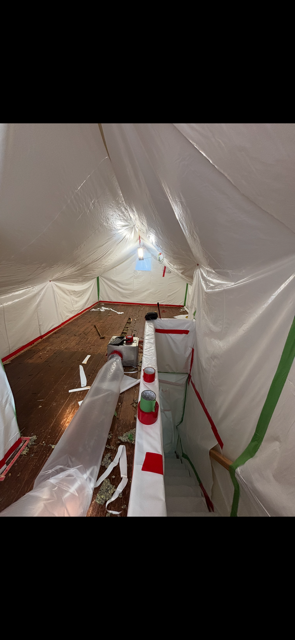
ACI-TECH, INC. is based in Chester, serves all of Chester County, and is familiar with the housing stock in Coatesville’s older neighborhoods. Contact us for an asbestos inspection or a free on-site estimate — (610) 497-7162. If testing confirms asbestos-containing materials, ACI-TECH provides asbestos removal under full PA-required containment and air clearance. For a complete overview of asbestos and lead paint risks throughout Chester County, including West Chester, Coatesville, and Phoenixville, see our Chester County asbestos and lead remediation guide.
Sources