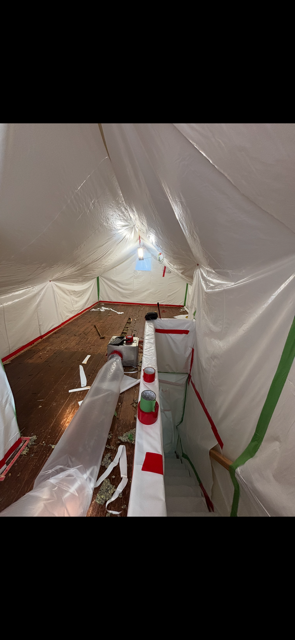
West Chester Borough’s pre-1940 housing stock has a high probability of containing asbestos-containing materials, and renovation is the point at which that probability becomes a practical concern. The borough’s Federal, Greek Revival, Victorian, and Edwardian homes were built and maintained during the same decades asbestos was in routine use across every trade — long before any regulatory oversight existed. If you’re planning a kitchen update, bathroom renovation, pipe replacement, or any project that involves removing original building materials in a West Chester Borough home, a pre-renovation asbestos inspection is the right first step.
What Makes West Chester’s Housing Stock Distinctive
West Chester Borough is the Chester County seat, and its residential character is unlike the county’s suburban townships. The walkable downtown grid and surrounding residential streets were developed continuously from the 1840s through the early 1920s, producing a dense concentration of Federal-style townhomes, Greek Revival single-family houses, Victorian-era brick singles and twins, and Edwardian-period construction — most of it stone or brick, most of it still standing and still occupied.
This is not typical suburban mid-century housing. Many West Chester homes are 100–150 years old. They predate the 9×9 floor tile era most homeowners associate with asbestos. The materials of concern in homes of this age are different — and often more embedded in the structure.
The Asbestos Materials Most Common in 1840s–1910s Construction
Steam heat pipe insulation — the highest-priority material. Victorian-era homes were heated with coal-fired steam boilers. When central steam heat was installed or retrofitted — typically from the 1880s through the 1920s — the distribution pipes running through the basement, along floor joists, and through wall chases were insulated with asbestos-containing wrap. In West Chester’s older homes, this insulation is often still in place: gray or whitish wrap on supply and return lines, sometimes with a canvas or plaster outer coat.
Pipe insulation is a friable material — it can crumble when disturbed — and it releases fibers readily when cut, broken, or disturbed by renovation work. It’s also frequently in poor condition in older homes after a century of thermal cycling, physical contact, and moisture exposure.
Asbestos-containing plaster. Asbestos fiber was incorporated into plaster mixes beginning in the late 1910s and continuing through the 1940s to improve fire resistance and workability. West Chester homes that received interior renovations or re-plastering during the 1920s through the 1940s may contain asbestos fiber in wall and ceiling plaster. This material is typically non-friable when intact, but sanding, scraping, or demolition releases fibers.
Transite (asbestos-cement) products. Asbestos-cement board — sold under the Transite brand and others — was introduced in the late 1920s and became common in the 1930s–1950s for roofing, siding, flue liners, and utility applications. A West Chester Victorian that received new roofing, siding, or exterior work between 1930 and 1960 may have transite materials. These are typically non-friable when intact, but cutting, drilling, or demolition generates asbestos dust.
Mid-century renovation materials. Many of West Chester’s Victorian homes were renovated in the 1940s–1960s. If a kitchen or bathroom was updated in that period, 9×9 vinyl-asbestos floor tiles are a common finding — even in a home originally built in 1890. Black mastic adhesive beneath those tiles almost always contains asbestos as well.
Why the Renovation Market Makes This Timely
West Chester Borough’s housing market is active, and the borough’s older stock attracts buyers specifically because of its architectural character. Victorian and Craftsman-era homes with original millwork, fireplaces, and stone construction command strong demand. That demand drives renovation — and renovation is when asbestos becomes a practical concern rather than a theoretical one.
The materials described above are generally stable and managed safely when left undisturbed. The risk appears when a contractor cuts into pipe insulation to replace a water line, sands plaster before repainting, removes original flooring, or demolishes a wall. At that point, fibers that were contained in a solid or wrapped form become airborne — and the exposure risk to occupants and workers is real.
What Pennsylvania Law Requires Before Renovation
Pennsylvania sets a clear threshold for contractor obligations. Under PA Department of Labor & Industry requirements, any renovation involving more than 3 linear feet of friable pipe or boiler insulation, or more than 3 square feet of other friable asbestos-containing material, requires a PA-certified asbestos contractor and notification to the Bureau of Workers’ Compensation.
Projects above the federal NESHAP thresholds — 260 linear feet of pipe, 160 square feet of surfacing material, or 35 cubic feet of other regulated asbestos material — require a 10-working-day advance notification to PA DEP, which covers Chester County through its Southeast Region office.
Pennsylvania also applies a “presumed to contain asbestos” standard during regulated renovation activity: suspect materials in pre-1980 buildings must be treated as asbestos-containing unless sampling demonstrates otherwise. Testing resolves the uncertainty and allows renovation to proceed with documented knowledge rather than assumptions.
These thresholds are relevant to contractors; the practical implication for homeowners is simpler: have suspect materials tested by a PA-certified asbestos inspector before renovation begins, regardless of project size. A positive test result that comes back before the contractor starts is workable. A positive result that comes back during demolition is a regulatory and logistical problem.
What a Pre-Renovation Inspection Involves
A pre-renovation asbestos inspection in a West Chester Victorian home typically involves:
- A visual survey of all areas affected by the planned renovation — basement, mechanical systems, walls, floors, ceilings
- Bulk sampling of suspect materials — small physical samples taken by the certified inspector and submitted to an accredited laboratory
- A written inspection report identifying each material sampled, the laboratory result, the condition of the material, and recommendations for abatement or management
The inspection itself is a few hours of work. Laboratory results typically return within 2–5 business days on standard turnaround, or 24–48 hours on rush analysis. The cost of the inspection is small relative to the cost of discovering asbestos mid-renovation — when work must stop, a contractor must mobilize unexpectedly, and schedules collapse.
ACI-TECH provides free written estimates for abatement. If the inspection findings require remediation before your contractor can proceed, we scope and price the abatement so you have a documented number before making decisions.
Historic District Considerations
Much of West Chester Borough’s older residential and commercial stock falls within the West Chester Historic District, administered by Chester County. Properties in the historic district already face review requirements for exterior alterations — replacement windows, siding changes, and similar work require approval from the borough’s Historic Architectural Review Board.
Asbestos testing fits naturally into the same pre-work diligence framework. If exterior work on a historic district property involves disturbing transite siding, roofing, or chimney materials, asbestos testing should be part of the planning process alongside historic review. The two processes run in parallel, not in sequence.
Before You Start Work
If you own a West Chester Borough home built before 1940 — and many built through the 1960s — and you’re planning renovation of any kind, the correct sequence is:
- Identify all materials that will be disturbed by the planned work
- Arrange for a PA-certified asbestos inspector to survey and sample those materials
- Receive and review the laboratory results
- If positive: arrange abatement before renovation begins
- If negative: proceed with documented confidence
This sequence protects your health, protects your contractor’s workers, keeps your project on schedule, and keeps you on the right side of Pennsylvania’s regulatory requirements.
ACI-TECH, INC. is based in Chester and serves all of Chester County, including West Chester Borough. Contact us for a pre-renovation inspection or a free written estimate — (610) 497-7162. If testing confirms asbestos, we provide asbestos abatement and removal under full containment and PA-required air clearance. For a complete overview of asbestos and lead paint risks across Chester County, see our Chester County asbestos and lead remediation guide.
Sources