Asbestos is genuinely dangerous when disturbed, but it is not immediately dangerous in every form and situation — and understanding that distinction is what separates useful information from panic. Here are six persistent myths about asbestos, corrected with what health authorities and the regulatory record actually say.
Myth 1: Any amount of asbestos exposure is immediately fatal
No single brief exposure to asbestos fibers causes instant illness. The diseases linked to asbestos — mesothelioma, asbestosis, and lung cancer — develop after fibers accumulate in lung tissue over many years. The International Agency for Research on Cancer classifies all six forms of asbestos as Group 1 carcinogens, meaning the causal link to cancer is established. But the risk is dose-dependent and latency is long: mesothelioma typically takes 20 to 50 years to develop after initial exposure.
That said, there is no established safe level of asbestos exposure. The EPA and OSHA both operate on the principle that reducing exposure as close to zero as possible is the correct approach — not that any specific low dose is provably harmless.
Myth 2: Only construction workers need to worry
Occupational exposure — in construction, shipbuilding, insulation work, plumbing, and automotive brake repair — has historically produced the highest disease burden. The World Health Organization has documented that workplace asbestos exposure affects an estimated 125 million workers globally.
But in Pennsylvania and throughout the Delaware Valley, the most common source of concern for homeowners today is disturbance of in-place building materials during renovation: cutting through old pipe insulation, sanding textured ceilings, removing 9×9 vinyl floor tiles, or demolishing walls in a pre-1980 home. You do not have to be in a trade to be at risk.
Myth 3: White asbestos (chrysotile) is safe
This claim — promoted largely by the chrysotile industry — is rejected by every major health authority. The World Health Organization, the EPA, and the International Agency for Research on Cancer all classify chrysotile as a known human carcinogen causing mesothelioma and lung cancer. Chrysotile accounts for more than 90% of asbestos ever commercially used and remains the most commonly found type in American homes and buildings.
All six recognized asbestos mineral types are classified as carcinogens. The amphibole types (crocidolite, amosite, tremolite, anthophyllite, actinolite) are generally considered more potent per fiber, but chrysotile is not safe.
Myth 4: Wetting asbestos prevents all fiber release
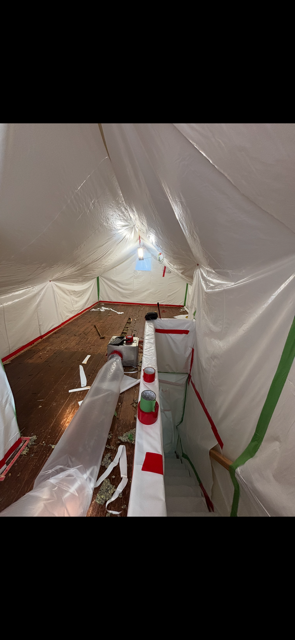
Controlled wetting is a standard professional abatement practice — it reduces airborne fiber counts during removal by preventing material from fracturing into dust. But wetting is a control measure used as part of a proper abatement procedure, not a DIY solution. It does not neutralize or encapsulate fibers, and it offers no protection for material that is already dry and disturbed. Several amphibole asbestos types are hydrophobic and wet poorly regardless.
Myth 5: You can identify asbestos by looking at it
You cannot. Asbestos fibers are microscopic and invisible to the naked eye. Asbestos-containing materials look identical to non-asbestos versions of the same product. The only way to confirm the presence of asbestos is laboratory analysis of a bulk sample, collected by a PA-certified asbestos inspector and analyzed by an accredited lab using polarized light microscopy (PLM) or transmission electron microscopy (TEM).
If your home was built or substantially renovated before 1980 and you’re planning work that will disturb existing materials, testing is the only responsible first step.
Myth 6: If it’s not crumbling, it’s fine to leave it
Friable asbestos — material that crumbles by hand pressure — poses a higher immediate risk because fibers are released more readily. Non-friable materials that are intact and undisturbed do pose lower immediate risk. But “lower immediate risk” is not the same as “permanently safe to ignore.”
Materials in good condition today can deteriorate. More critically, planned renovation work instantly changes the equation: a non-friable vinyl floor tile becomes a high-risk situation the moment someone tries to pry it up dry or sand the adhesive beneath it. Testing and professional assessment before any planned disturbance is the right call regardless of current condition.
If you’re in Chester, Delaware County, or the Philadelphia area and have concerns about materials in your home, ACI-TECH, INC. provides licensed asbestos inspection and testing services. If testing confirms asbestos, we also provide professional removal under proper containment. Call (610) 497-7162 for a free estimate.