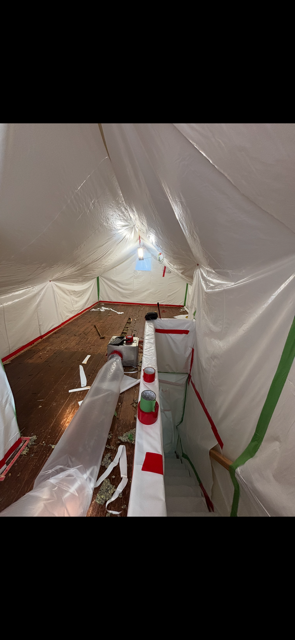
The asbestos-containing materials most commonly found in pre-1980 Delaware County and Philadelphia homes are vinyl floor tiles and their adhesive, pipe and duct insulation on heating systems, spray-applied ceiling texture, joint compound on walls, and asbestos-cement (transite) siding and roofing. The EPA estimates asbestos-containing materials are present in most homes built before 1980. Because you cannot identify asbestos by sight alone, knowing which product categories historically contained it tells you what to test before any renovation work disturbs existing materials.
The following types appear most frequently in pre-1980 homes in Delaware County, Chester, and the wider Philadelphia area, organized by where in the home you’re likely to encounter each one.
Vinyl Floor Tiles and Adhesive
The most commonly encountered asbestos-containing material in mid-century Delaware County homes is the 9×9 inch vinyl floor tile, manufactured in enormous quantities from the late 1940s through the 1970s. Chrysotile asbestos was added to the vinyl compound — typically 15% to 25% by weight — as a reinforcing fiber. The black mastic adhesive used to set these tiles frequently also contains asbestos and should be tested at the same time as the tile.
Intact, adhered floor tiles are generally non-friable and low-risk. The risk increases significantly when tiles are pried up dry, when the adhesive is sanded off, or when tiles have cracked and crumbled. Do not attempt to remove 9×9 tiles from a pre-1980 home without testing first.
Pipe and Duct Insulation
Wrap insulation on hot water pipes and steam distribution pipes — particularly in basements — was one of the most common uses of asbestos in residential construction through the 1970s. This material is often friable: it crumbles by hand pressure and can shed fibers in normal conditions when it deteriorates. Deteriorating pipe insulation is one of the higher-priority materials for professional assessment.
HVAC duct insulation from the same era also sometimes contained asbestos. Any wrap insulation in a mechanical room or basement of a pre-1975 home should be assumed potentially asbestos-containing until tested.
Spray-Applied Textured Ceiling Finishes
Popcorn or acoustic spray-on ceiling texture was used extensively in residential construction from the 1950s through the late 1970s. The EPA banned asbestos in spray-applied surfacing materials in 1973, but product inventory manufactured before the ban was installed through the decade.
Spray-on ceiling materials are classified as friable — they can crumble under ordinary pressure and shed dust during incidental contact. This makes them a higher priority than non-friable materials for testing, particularly before any renovation that involves the ceiling.
Drywall Joint Compound and Textured Paint
Joint compound used to tape and finish drywall seams, and some textured wall paints, contained chrysotile asbestos through approximately 1977. This is most relevant during renovation — sanding walls or ceilings in a pre-1980 home can disturb asbestos-containing joint compound and create a significant airborne fiber event. Testing should be done before any sanding work in a pre-1978 home.
Asbestos-Cement Products
Asbestos-cement — a composite material mixing Portland cement with chrysotile asbestos fibers — was used extensively in roofing shingles, exterior siding, flue pipes, and some interior wall panels. These products are generally non-friable when intact: they do not readily release fibers in normal use.
The risk arises when asbestos-cement is cut, drilled, broken, or weathered to the point of crumbling. Roofing and siding replacement projects on pre-1980 homes frequently encounter asbestos-cement shingles. Contractors performing this work must treat it as asbestos-containing unless tested.
Boiler and Furnace Insulation
Older oil or gas boilers and warm-air furnaces from before the mid-1970s were commonly fitted with asbestos board insulation, asbestos blanket wrap, and asbestos rope gaskets. This equipment is approaching 50 years old and the insulation is often brittle, crumbling, and releasing fibers in the mechanical room. If you have an older boiler or furnace and its insulation is visibly deteriorating, have it assessed by a licensed asbestos inspector before the next heating season.
Vermiculite Attic Insulation
Vermiculite loose-fill insulation was sold extensively from the 1940s through the 1980s under the brand name Zonolite. The primary source of vermiculite for these products was a mine in Libby, Montana that also contained tremolite asbestos deposits. The EPA has documented that Libby-sourced vermiculite is frequently contaminated with tremolite asbestos.
The EPA advises homeowners not to disturb vermiculite attic insulation and to have it tested before any work in the attic. Vermiculite insulation is typically gray, silver-brown, or gold in color, with an expanded pebble-like appearance. If your pre-1990 home has this type of insulation, treat it as potentially asbestos-containing.
What to Do If You Suspect Any of These Materials
Do not disturb suspected materials before testing. Contact a PA-certified asbestos inspector to collect samples and have them analyzed. Testing is relatively inexpensive, takes only a few days, and answers the question definitively.
ACI-TECH, INC. provides licensed asbestos inspection and testing services in Chester, Delaware County, and the Philadelphia area. If testing confirms asbestos, we provide professional abatement with proper containment and disposal. Call (610) 497-7162 for a free estimate.