DIY asbestos removal is the most dangerous way to handle asbestos-containing material — not because professionals have some magic method, but because the act of removal itself is when fibers are released in the highest concentrations, and because most homeowners lack the training, equipment, and containment to do it without contaminating their home.
The diseases caused by asbestos exposure — mesothelioma, lung cancer, and asbestosis — develop 10 to 50 years after the exposure. Someone who breathes in a significant amount of asbestos fiber during a weekend DIY project will feel nothing at the time. They will not know what they’ve done to themselves for potentially decades. That delayed consequence is what makes the risk so easy to underestimate.
What Happens When You Disturb Asbestos Incorrectly
When asbestos-containing material is cut, scraped, sanded, pried apart, or drilled without proper containment:
- Microscopic fibers become airborne throughout the work area.
- Without negative-pressure containment, fibers spread through HVAC systems and air movement into other rooms.
- Fibers settle on all surfaces — furniture, carpet, clothing, ductwork.
- Standard HEPA vacuum filters are required to capture asbestos fibers; regular shop vacs recirculate them.
- Fibers can remain in a home for years if not properly cleaned with HEPA equipment.
The result of poor DIY removal can be an entire home that is more contaminated after the work than before it, requiring professional decontamination of areas well beyond the original work zone.
The Diseases at Stake
Mesothelioma
Mesothelioma is a cancer of the lining surrounding the lungs and abdomen, and asbestos exposure is its predominant cause. It has a latency period of 20 to 50 years. Once diagnosed, it is aggressive and difficult to treat. The National Cancer Institute estimates approximately 3,000 new mesothelioma cases are diagnosed in the United States annually, most of them traceable to occupational or residential asbestos exposure from decades earlier.
Asbestosis
Asbestosis is irreversible scarring of lung tissue caused by accumulated asbestos fibers. The condition is progressive — it worsens over time — and there is no treatment that reverses the damage. Symptoms include shortness of breath, persistent dry cough, and reduced oxygen capacity.
Lung Cancer
Workers with significant asbestos exposure have a substantially elevated risk of lung cancer compared to the general population, according to the National Cancer Institute. The risk is multiplied further by cigarette smoking. Symptoms — persistent cough, chest pain, shortness of breath — often do not appear until cancer is at an advanced stage.
What Pennsylvania Law Actually Allows
Pennsylvania has a private residence exemption under PA DEP’s NESHAP enforcement: a homeowner who personally removes asbestos materials from their own single-family home is not required to notify PA DEP under the NESHAP standard. This is often misread as permission to proceed unsafely.
The exemption does not mean:
- The work is safe without proper equipment and precautions
- Asbestos waste can go in regular trash
- A contractor doing work on your behalf is exempt from OSHA asbestos regulations or contractor certification and notification requirements
- Air clearance testing is not needed to confirm the space is safe after work
Even under the private residence exemption, proper disposal is still required: asbestos-containing waste must be disposed of as hazardous waste at a PA DEP-permitted facility, double-bagged in labeled sealed bags or properly contained. Dumping asbestos in a landfill or dumpster is illegal.
What Professional Abatement Involves That DIY Cannot Replicate
A licensed PA abatement contractor provides:
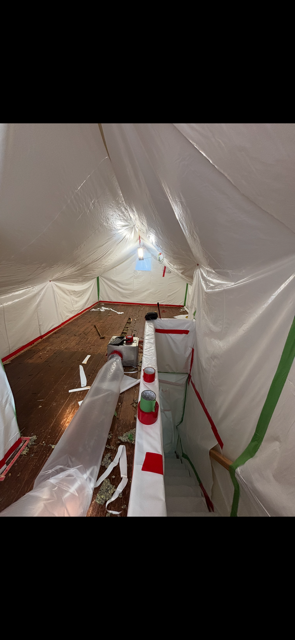
- Negative-pressure containment: Plastic sheeting seals the work area and HEPA-filtered exhaust fans create negative pressure so contaminated air moves out of the zone rather than into adjacent spaces.
- Proper respiratory protection: Full-face or half-face respirators with P100 filters, appropriate to the fiber concentrations being generated.
- Wet methods: Keeping material wet during removal reduces airborne fiber counts.
- HEPA decontamination: HEPA vacuums and wet wiping of all surfaces in the work zone after removal.
- Air clearance testing: An independent industrial hygienist collects air samples after cleanup. Work is not complete until air clearance passes — fiber counts below the clearance threshold confirm the space is safe for occupancy.
- Regulated waste disposal: Proper manifesting and disposal at an approved facility.
- Documentation: A record of the project, notifications filed, and clearance test results — which matters for future property transactions and for your own records.
The Practical Bottom Line
If you have asbestos-containing material in your home in Chester or Delaware County that needs to be addressed, the right sequence is: licensed inspection to confirm what you have, then licensed abatement if removal is needed. The cost of professional abatement is real — but it is finite, and it is far less than the cost of a contaminated home or a mesothelioma diagnosis.
ACI-TECH, INC. provides licensed asbestos abatement services for homes in Chester, Delaware County, and the Philadelphia area. Every project begins with professional asbestos testing to confirm what’s present before any removal work. Call (610) 497-7162 for a free estimate.
Sources
- National Cancer Institute — Mesothelioma statistics and diagnosis
- National Cancer Institute — Asbestos and Cancer Risk
- PA Department of Labor & Industry — Asbestos Contractor Certification and Notification Requirements
- EPA — Frequent Questions About Asbestos (waste disposal requirements)
- OSHA — Asbestos Regulations and Worker Protection