If you’re buying a pre-1980 home in Delaware County, include an asbestos testing contingency in your purchase agreement. The Delaware Valley Regional Planning Commission (DVRPC) documents that more than 57% of county housing units were built before 1960 — and in the inner boroughs where most buyers focus (Chester, Upper Darby, Lansdowne, Darby, Collingdale, Folcroft), that number is significantly higher. For a row home, twin, or single-family in this market, asbestos-containing materials are the rule in pre-war housing, not the exception. This isn’t a reason to walk away from an older property. It is a reason to know what you are buying before you close.
What General Home Inspections Cover in Delaware County
Delaware County’s dense row home and twin market creates a specific dynamic in pre-purchase inspections. Because the same house design — pre-war brick row home with original steam heat, original basement floor tiles, and original attic insulation — repeats across hundreds of parcels in Chester, Upper Darby, Lansdowne, and Darby, experienced inspectors in this market know exactly what to look for and where.
A licensed general home inspector familiar with Delaware County’s pre-war row homes will note suspect materials and flag them for specialist follow-up. What a general inspector cannot do:
- Take bulk samples for laboratory analysis
- Issue a formal asbestos inspection report
- Provide a regulatory determination about specific materials
When an inspection report on a row home in this market returns language like “suspect asbestos-containing pipe insulation observed on basement steam lines — recommend testing by a PA-certified asbestos specialist,” follow that recommendation before the inspection contingency expires. This language is not unusual here — it’s the standard written output on most pre-1950 row homes with original mechanicals, and experienced listing agents in this market expect it.
Understanding the Disclosure Form in Delaware County’s Housing Market
Under Pennsylvania’s Real Estate Seller Disclosure Law, sellers must disclose known material defects, including known asbestos-containing materials. The operative word is known — a seller who has never tested is not required to test before sale. They disclose what they know; they are not required to find out.
The practical reality in Delaware County: most sellers of pre-war row homes have never had a formal asbestos inspection. The disclosure form says “no known asbestos” because the pipes were always there and nobody looked. This is not misrepresentation; it is the standard state of affairs in this market.
Federal law requires sellers of pre-1978 homes to provide the EPA/HUD pamphlet Protect Your Family From Lead in Your Home and disclose known lead hazards. The same “known” qualifier applies. With the Delaware County Health Department estimating 80% of county homes contain lead-based paint, “no known lead hazards” typically means no one has tested — not that no lead is present.
Building an Asbestos Contingency in a Delaware County Transaction
The standard approach when buying a pre-1980 property here is to include an asbestos testing contingency in the purchase agreement — a defined window (typically 10–14 days) for a PA-certified asbestos inspector to survey the property and collect samples from suspect materials.
In the Upper Darby, Lansdowne, and Chester markets, real estate attorneys and buyers’ agents who regularly work this housing stock are accustomed to asbestos contingencies. This is not an unusual ask; it is standard due diligence on a pre-1960 row home or twin.
If testing returns positive results, the Delaware County market has established patterns for handling it:
- Request abatement before closing (seller pays and provides clearance documentation)
- Request a price reduction reflecting written abatement estimates
- Request a credit at closing
- Walk away within the contingency window if the scope is unacceptable
ACI-TECH provides written estimates suitable for purchase negotiations. We can typically schedule an inspection and return a report within the timeframe of a standard contingency period.
What to Have Tested in a Typical Delaware County Row Home or Twin
The EPA identifies asbestos-containing materials in older homes as a priority concern in pre-1980 construction — particularly pipe insulation, floor tiles, and ceiling textures that can become friable with age. The materials most frequently found in Delaware County’s pre-1980 housing stock, in order of priority:
Basement — highest priority:
- Pipe and boiler insulation on steam or hot water heating systems. In Chester, Upper Darby, and Darby row homes with original steam heat, pipe insulation is the most common asbestos-containing material — and it’s frequently friable (crumbling), making it the highest-urgency finding.
- Floor tiles and black mastic adhesive. Original basement floors in pre-war row homes commonly have 9×9 vinyl-asbestos tiles.
- Duct wrap and duct tape near the furnace on forced-air systems.
Kitchen and bathrooms:
- 9×9 vinyl floor tiles — the most common positive finding in mid-century renovations. Standard colors: beige, tan, gray, black, dark green.
- Sheet vinyl flooring where the backing or adhesive may contain asbestos.
Throughout the home:
- Textured or acoustic ceiling coatings if original
- Joint compound on plaster or early drywall
Exterior:
- Original roof shingles on pre-1980 flat roofs (built-up roofing on row homes)
- Transite (asbestos-cement) siding on additions or garages
Attic:
- Vermiculite loose-fill insulation. If present in a Delaware County row home attic, test it before any attic work. A significant portion of vermiculite sold before 1990 came from a Libby, Montana mine contaminated with tremolite asbestos, per EPA documentation.
What Abatement Costs — and How to Use Estimates in Negotiation
Asbestos abatement cost in a Delaware County row home varies by material type, quantity, and condition. A single-room floor tile abatement is a different scope from a full-building pipe insulation abatement on an original steam system.
ACI-TECH provides free written estimates. If you need a cost estimate to support a price reduction request during a purchase negotiation, we can provide a written scope and estimate based on the inspection findings. Buyers’ attorneys and agents in this market know how to use abatement estimates in negotiations — having a written number from a licensed contractor makes the request concrete.
After You Close: What to Address First in a Delaware County Row Home
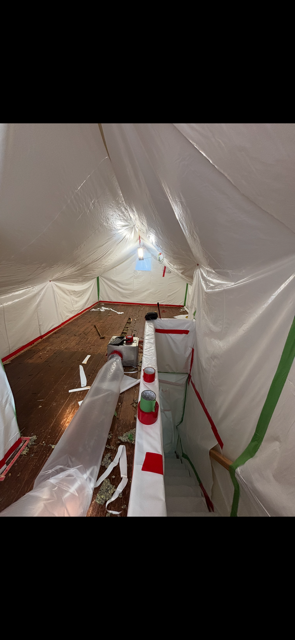
Row homes create specific post-purchase priorities that standalone single-family homes do not. Because party walls are shared with neighbors, any abatement work in a row home requires proper containment to prevent cross-contamination — standard protocol for a licensed contractor, but something that affects scheduling and access in ways unique to attached housing.
If you purchase a Delaware County row home with known asbestos-containing materials that are intact and not being disturbed, immediate abatement is not always required. The practical framework for this housing type:
- Abate before any renovation that opens walls or floors. In a row home, renovation work is more likely to reach original materials — plaster walls, original tile, pipe systems that run through shared wall cavities. Any material that will be disturbed must be removed first under PA L&I regulations.
- Abate deteriorating pipe insulation immediately. Crumbling pipe wrap on original steam heat lines releases fibers without any renovation activity. In basements with original mechanicals, this is the most common immediate health concern and should not wait for a planned renovation.
- Document and manage intact materials in place. Original tile in a basement or kitchen that is undisturbed and in good condition does not require immediate abatement. Get a written inspection report noting the location and condition, and revisit it before any future project that affects those areas.
A pre-1980 Delaware County home with known asbestos is a standard purchase in this market, not a problem property. The risk is not in owning one — it is in renovating one without knowing what is in the walls.
ACI-TECH, INC. serves buyers, sellers, and property managers throughout Delaware County and Chester. For pre-purchase inspections or abatement estimates in Chester, Upper Darby, Lansdowne, Darby, or any of the county’s 49 municipalities, call (610) 497-7162 or contact us online. We handle asbestos testing and inspection, abatement, and removal. Free estimates, seven days a week.
Sources
- DVRPC — Delaware Valley Housing Stock Data
- EPA — Asbestos in Your Home
- EPA — Vermiculite Insulation and Asbestos Risk
- EPA/HUD — Protect Your Family From Lead in Your Home (Real Estate Disclosure)
- Delaware County Health Department — Lead Action Plan (307 children, 80% county homes)
- PA Department of Labor & Industry — Asbestos Contractor Requirements