Sun Shipbuilding & Drydock Company operated on a 200-acre site along the Delaware River in Chester, Pennsylvania from 1917 to 1989. At its August 1943 wartime peak, the yard employed 35,633 workers — the largest single shipyard in the world at that time. For the men and women who built tankers, cargo vessels, and naval ships there, asbestos was an inescapable daily presence. And for their families living in Chester’s surrounding row homes, the exposure didn’t end when the workday did.
What Made Shipyards So Heavily Contaminated
Asbestos was used in every part of a ship that needed insulation, fire protection, or gasket sealing — which meant virtually every trade at Sun Ship worked with it. Pipe fitters, insulators, boilermakers, welders, machinists, and painters all encountered asbestos-containing materials as a routine part of their work.
Documented asbestos products used at Sun Shipbuilding included:
- Unibestos and Caltemp — pipe and boiler insulation products
- Kaylo — a widely used pre-formed pipe covering containing asbestos
- Pabco — asbestos insulation board manufactured by Fibreboard
- Garlock gaskets — asbestos sheet gaskets used throughout ship plumbing systems
- Raybestos — asbestos friction and gasket products
A pipefitter who worked at the yard from 1959 to 1976 testified in litigation (Lilley v. Johns-Manville Corp.) that “his clothes and body were covered with asbestos fibers at the end of every workday.” This testimony reflects conditions that were standard across the industry during that period, not an isolated incident.
Secondary Exposure: When the Fibers Came Home
Secondary exposure — also called take-home or para-occupational exposure — is a documented and well-established asbestos exposure pathway. It works like this:
Asbestos fibers are microscopic and light. They cling to work clothing, hair, skin, and tools. A worker who spent the day in a ship’s engine room surrounded by pipe insulation dust would carry those fibers home at the end of the shift. If his wife laundered his work clothes, she shook loose the fibers. If his children greeted him at the door, they were exposed. If the work clothing sat in a shared laundry area in a row home basement, the fibers settled throughout the home.
This is not speculation — secondary asbestos exposure from shipyard workers is documented in mesothelioma and asbestos disease litigation across multiple decades, affecting family members who never set foot inside a shipyard.
Chester’s housing pattern made secondary exposure particularly concentrated. The brick row homes and twins within walking distance of the Sun Ship site housed generations of shipyard workers and their families. Many of these homes are still standing.
What This Means for Chester Homes Today
Secondary exposure affects air quality, not building materials. But there is a second issue that affects homes directly: the general era of Chester’s residential construction.
The same decades when Sun Ship was at peak operation — 1940s through the 1960s — were the peak years for residential asbestos use in American construction. Chester’s row homes were built or renovated during this period with pipe insulation, floor tiles, boiler insulation, roofing materials, and plaster that routinely contained asbestos.
A Chester home built in 1935 and renovated in 1955 may have:
- Original steam pipe insulation still wrapped in asbestos
- 9×9 vinyl floor tiles installed in a mid-century kitchen renovation
- Asbestos-cement roofing or siding added in the postwar period
- Textured ceiling plaster applied during mid-century updates
These are building material hazards, separate from any secondary exposure. But they exist in the same homes and the same neighborhoods, and they require the same professional attention: testing before disturbance, and licensed abatement if confirmed.
The Current Status of the Sun Ship Site
The Sun Ship facility operated until 1989. The site along the waterfront has undergone various redevelopment uses since then. PA DEP has conducted environmental monitoring in the Chester waterfront area. Homeowners with questions about site-specific environmental conditions near the former shipyard can contact PA DEP Southeast Region at (484) 250-5920 or the EPA Region III office.
If You Lived in a Shipyard Worker’s Home
If you grew up in or currently live in a home that housed Sun Ship workers — or any shipyard, industrial, or manufacturing worker who worked with asbestos materials — secondary exposure is a legitimate concern to discuss with your doctor. Medical surveillance for asbestos-related disease is available; the Mesothelioma Applied Research Foundation and the National Cancer Institute publish guidance on screening for people with documented exposure histories.
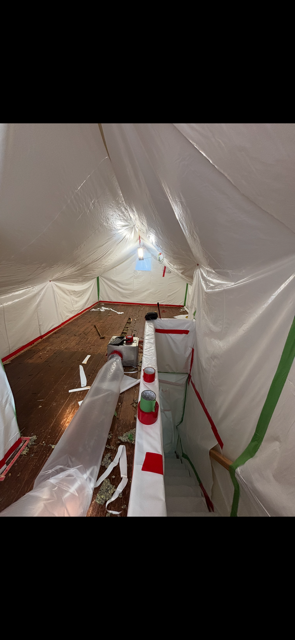
For the home itself: a baseline asbestos inspection tells you what materials are present, what condition they’re in, and whether any require remediation. This is a practical step that gives you documented information — not anxiety based on uncertainty.
ACI-TECH, INC. is based at 2300 W. 4th Street in Chester. We’ve worked in Chester’s housing stock for over two decades. Contact us for a free on-site estimate, or schedule an asbestos inspection if you’re planning renovation. If testing confirms asbestos-containing materials, ACI-TECH provides professional asbestos removal and abatement under full containment. For a complete overview of asbestos and lead risks throughout Chester’s row home stock, including what inspectors most commonly find, see our Chester, PA asbestos and lead remediation guide. Call (610) 497-7162.
Sources
- Encyclopedia of Greater Philadelphia — Shipbuilding and Shipyards — peer-reviewed academic reference; source for employment figures and production statistics
- Sun Shipbuilding and Dry Dock Co. 1916–1982: A Short History — official company history document; source for 35,633 peak employment figure (August 1943)
- Sun Ship: Vessels of Progress — PA State Library Literary and Cultural Heritage Map
- PA DEP Southeast Region — Environmental Monitoring
- Mesothelioma Applied Research Foundation — Secondary Exposure