If you’ve found gray or white fibrous wrap on pipes in your basement and your home was built before 1980, stop and read this before touching anything. That material has a high probability of being asbestos-containing pipe insulation — one of the most common, and potentially most hazardous, asbestos materials found in older Delaware County and Philadelphia row homes.
Here is a straightforward framework for what to do next.
Why Basement Pipe Insulation Is the Highest-Priority Concern
Asbestos was used extensively as pipe insulation from the 1920s through the late 1970s. Steam and hot water heating systems — standard in virtually every Delaware County and Chester row home built before 1960 — required insulation on supply lines to maintain heat and prevent burns. Asbestos was the insulation material of choice because it withstood the temperatures involved.
Unlike vinyl floor tiles (which are non-friable and relatively stable when intact), pipe insulation is a friable asbestos material. The EPA’s guidance on asbestos in the home identifies deteriorating pipe insulation as the highest-priority asbestos concern in older residential buildings. As it ages, the outer jacket deteriorates, the fibrous insulation beneath becomes exposed, and it can begin releasing fibers without any physical disturbance. In a basement with any air movement — from the furnace, from windows, from foot traffic — those fibers circulate.
This is why deteriorating pipe insulation is treated as a priority abatement situation rather than a “manage in place” scenario.
What You’re Likely Looking At
Several different materials appear on older pipes. Knowing what you’re looking at doesn’t confirm or rule out asbestos — only laboratory testing can do that — but it helps you understand what you’re dealing with:
Corrugated cardboard-like wrap with a cloth outer jacket: Common in pre-1950 installations. The inner core is typically asbestos fiber, often loosely packed. When the outer jacket cracks or falls away, the fibrous interior is exposed. High probability of asbestos; handle as asbestos until proven otherwise.
Smooth plaster-like coating on pipes: Often an asbestos-containing compound applied over pipe fittings and joints, smoothed out by hand. Frequently found at elbows, tees, and valve connections. High probability of asbestos.
Gray foam or rubber-like material: More likely to be post-1980 fiberglass or foam insulation, which does not contain asbestos. But if the home has multiple renovation layers, there can be old asbestos wrap beneath newer material. Test if uncertain.
White or gray fiberglass batt wrapped around pipes: If fluffy and yellow-white in color, this is likely fiberglass, which does not contain asbestos. However, an older asbestos layer may be underneath it.
Bright orange or yellow tape at joints: Modern HVAC tape — not asbestos. But check what’s underneath.
What Not to Do
- Do not touch, disturb, or attempt to remove any fibrous pipe insulation until it has been tested.
- Do not sweep or vacuum debris from deteriorating insulation with a standard vacuum. Standard vacuums exhaust fine particles — including asbestos fibers — directly back into the air. Only HEPA-filtered vacuums are appropriate.
- Do not attempt to wrap deteriorating insulation yourself with duct tape or new material. This is not a valid containment method and may indicate to a future inspector that you disturbed the material.
- Do not proceed with any renovation work in the basement until the insulation status is known.
Assessing the Urgency
Not all pipe insulation situations are equally urgent. The condition of the material matters:
Intact, fully jacketed, no visible deterioration: Lower urgency. Have it professionally inspected and tested, document the results, and schedule abatement before any renovation or HVAC work. Until then, avoid unnecessary time in the basement and limit disturbance.
Jacket cracking or sections coming off, but inner material still largely intact: Moderate urgency. Limit basement access, especially for children and anyone with respiratory conditions. Schedule a professional inspection promptly.
Inner fibrous material visible and crumbling, debris on floor or pipes: High urgency. Limit all access to the basement. This is a priority abatement situation. Call a licensed abatement contractor — do not wait for your next renovation project.
Significant debris on floor, widespread deterioration: Treat this as an emergency. Limit access to the home if the HVAC system is drawing air from the basement. Call a licensed contractor immediately.
What the Professional Process Looks Like
A PA L&I-certified asbestos inspector takes a small sample of the suspect material — minimally invasive, takes a few minutes — and submits it to an accredited laboratory. Results come back in 3–5 business days (rush analysis in 24–48 hours is available).
If the sample tests positive, the inspector’s report documents the material, its location, estimated quantity, and condition. For deteriorating pipe insulation, abatement is almost always recommended rather than encapsulation.
Abatement involves:
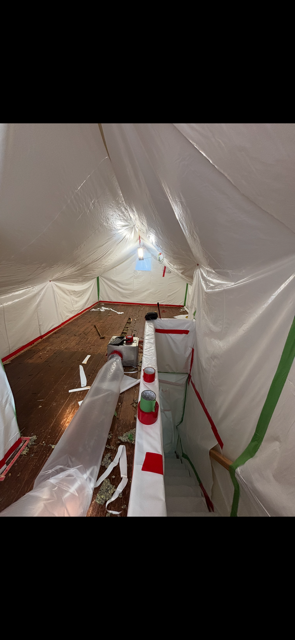
- Establishing full containment around the work area with negative air pressure
- Wetting down the insulation to suppress fiber release during removal
- Carefully removing all insulation and debris
- HEPA vacuuming all surfaces
- Post-abatement air clearance testing before containment is removed
After abatement, your pipes can be re-insulated with modern, asbestos-free materials.
What This Costs
Pipe insulation abatement costs vary with the linear footage of pipe, accessibility, and whether the system requires partial demolition to access. ACI-TECH provides free written estimates that give you a specific scope and cost before any commitment.
If you’re in Chester, Delaware County, or the Philadelphia area and you’ve found suspicious pipe insulation, call (610) 497-7162 or contact us online. We can typically schedule a same-week asbestos inspection. If the inspection confirms asbestos, we handle the abatement as well. Do not let uncertainty turn into delay when you have potentially friable material in your home. For more on the steam pipe insulation risks in Chester’s pre-war row homes specifically, see our Chester, PA asbestos and lead remediation guide.
Sources