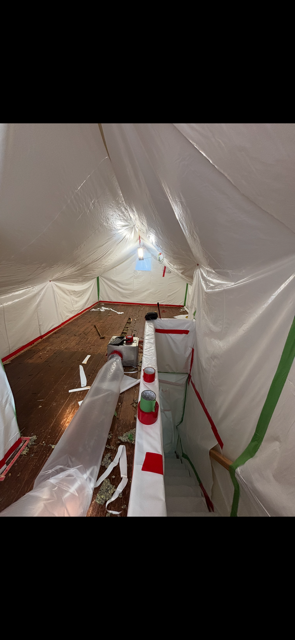
The only reliable way to tell if 9×9 floor tiles contain asbestos is laboratory testing — you cannot confirm it by sight, feel, or color alone. That said, size and age are strong predictors: if your home was built or renovated between 1947 and 1981 and still has original 9×9 inch vinyl flooring, there is a high probability those tiles contain chrysotile asbestos — and so does the black adhesive beneath them. 9×9 vinyl floor tiles are the single most commonly encountered asbestos-containing material in pre-1980 homes across Delaware County, Chester, and Philadelphia.
This doesn’t mean you’re in immediate danger. But it does mean you should not remove, sand, drill, or cut those tiles without knowing what you’re working with.
Why 9×9 Tiles Are Different From Other Flooring
Vinyl-asbestos tiles (VAT) were the dominant residential floor covering from the late 1940s through the mid-1970s. Asbestos was mixed into the vinyl compound as a reinforcing fiber — typically 15 to 25% chrysotile by weight — because it made the tiles more durable, flexible, and heat-resistant.
The 9×9 inch format was the residential standard. 12×12 tiles came later (roughly late 1960s onward) and can also contain asbestos, but the 9×9 size is the most reliable visual indicator that you’re looking at mid-century material.
The black mastic adhesive used to set these tiles is equally important. It frequently tests positive for asbestos independently of the tiles themselves. Even if you encapsulate or cover the tiles without removing them, the mastic beneath remains in place.
How to Identify Potentially Asbestos-Containing Floor Tiles
You cannot confirm asbestos by sight. Only laboratory analysis of a sample can do that. But these characteristics make 9×9 tiles worth testing before any work:
- Size: Exactly 9 inches × 9 inches. Measure before assuming.
- Age: In kitchens, bathrooms, basements, or hallways of homes built or renovated between 1947 and 1981.
- Appearance: Typically solid color or simple marbled pattern — common colors include beige, tan, gray, black, dark green, and brown. The patterns are simple by modern standards.
- Feel: Slightly brittle compared to modern vinyl. Some have a chalky or soft surface if degraded.
- Adhesive visible at edges: Lifted or cracked tiles often reveal a thick black or dark brown adhesive. This black mastic should be tested at the same time as the tiles.
- Layered floors: If you find resilient flooring installed over original flooring, the layer beneath is worth testing. Multiple renovation generations are common in Delaware County row homes.
When Are They Dangerous?
Intact, undisturbed vinyl-asbestos tiles that are firmly adhered to the floor and not cracked, chipped, or friable generally do not release significant airborne fibers in normal use. The EPA classifies intact VAT as a lower-priority concern compared to friable materials like deteriorating pipe insulation.
The risk rises sharply when tiles are:
- Mechanically disturbed — scraped, chipped, sanded, ground, or drilled
- Removed dry — dry removal is the highest-risk approach for floor tiles
- Deteriorating — cracked, broken, or crumbling tiles can release fibers without any disturbance
- Covered by sanding — sanding the subfloor after removal is an extremely high-risk activity if residual mastic remains
A common mistake is sanding old black mastic off a concrete subfloor after removing tiles. This is one of the most hazardous DIY asbestos exposures a homeowner can create.
What Pennsylvania Law Requires
In Pennsylvania, licensed contractors must notify the Department of Labor & Industry before performing asbestos work above the de minimis threshold (3 linear or square feet of friable material for indoor projects). For most floor tile removal, the volume is above this threshold unless you’re addressing a very small area.
Pennsylvania does have a private residence exemption — homeowners can technically remove materials themselves from their own single-family home without DEP notification. However, this exemption does not make the work safe. Proper containment, respirator (at minimum a half-face respirator with P100 filters), disposable PPE, HEPA vacuuming, and proper disposal at an approved facility are all required regardless of who does the work.
For renovation projects where a contractor is involved, EPA RRP lead regulations also apply if the project disturbs 6 or more square feet of painted surfaces — common when removing old flooring in pre-1978 homes.
The Right Process Before Any Floor Renovation
- Assume, then test. If your home was built or renovated before 1981 and you haven’t tested the floors, assume VAT may be present.
- Do not disturb. Do not scrape, chip, or lift tiles to see what’s underneath before knowing what you’re dealing with.
- Call a licensed inspector. A PA-certified asbestos inspector takes a small sample — the process is minimally invasive and tiles remain intact during sampling.
- Wait for lab results. Turnaround is typically 3–5 business days.
- Decide on your approach. If positive: encapsulation (installing new flooring directly over intact tiles), enclosure (new subfloor over tiles), or abatement (licensed removal). Your inspector can advise which is appropriate given the tile condition.
If you’re in Chester, Delaware County, or the surrounding area and planning a kitchen renovation, basement finishing, or any project involving older resilient flooring, ACI-TECH, INC. can complete a pre-renovation asbestos inspection before any work begins. If the inspection confirms asbestos floor tiles, we handle the asbestos removal as well. Free estimates are available seven days a week — call (610) 497-7162. For a first-hand account of asbestos floor tile found during a Chester basement renovation, see Chester Row Home Basement Renovation: Asbestos Floor Tiles Under the Debris.
Sources