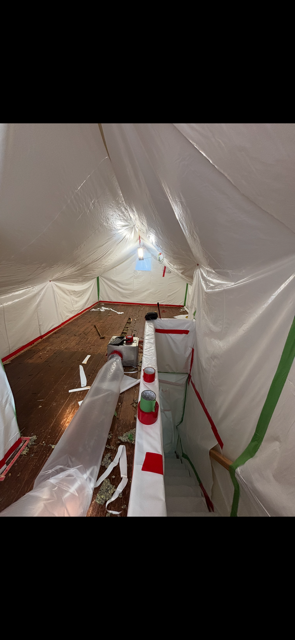
Whether you can stay in your home during asbestos removal depends on the scope of the project and the containment setup — not on a blanket rule. For a contained, limited abatement (removing floor tiles in one room, for example), occupants can typically remain in unaffected parts of the home with proper containment barriers in place. For larger projects involving significant quantities of friable material, whole-house displacement is standard.
Here is how licensed abatement contractors make that determination, and what you should ask before any work begins.
What “Containment” Means and Why It Matters
Licensed asbestos abatement contractors are required to establish a regulated work area — a sealed containment zone around the affected material. Proper containment includes:
- Polyethylene sheeting sealing all openings, HVAC vents, and doorways in the work area
- Negative air pressure maintained by HEPA air filtration units venting filtered air outside the building — this ensures that any fibers generated during work flow toward the filter, not outward into the home
- Decontamination unit — a series of chambers (clean room, shower area, equipment room) through which workers enter and exit, so fibers are not tracked out on clothing or equipment
- Critical barriers at any doorway between the work area and occupied space
When this containment is properly established and maintained, the work area is effectively isolated from the rest of the building. Air monitoring during the project confirms that fiber levels outside the containment remain below action levels.
Projects Where Staying Is Typically Acceptable
For small to moderate projects with good containment, many homeowners remain in unaffected areas of the home while work proceeds. Examples that commonly allow in-home occupancy:
- Floor tile abatement in one room — a kitchen, bathroom, or basement area with all openings sealed. Occupants use other rooms during the work day and return after the daily cleanup.
- Limited pipe insulation — a short run of pipe insulation in a boiler room or crawl space, with the space fully sealed off from living areas.
- Roof or exterior work — asbestos-cement shingle removal from the exterior typically does not require occupants to leave, though the work area directly below should be avoided during active removal.
Your contractor should explain the containment plan before work starts. If they can’t describe the negative air setup and barrier locations specifically, ask them to do so.
Projects Where Temporary Relocation Is Recommended
Some projects require — or strongly warrant — occupants leaving the home temporarily:
- Friable pipe insulation throughout the building — steam systems in older Delaware County row homes can have continuous pipe runs from the basement through every floor. Abating the full system means working in multiple areas simultaneously, and containment zones throughout an occupied home are more complex to maintain safely.
- Heavily deteriorated material — asbestos materials that are already crumbling (deteriorating pipe insulation, for example) are releasing fibers before any work begins. If the material is in a living area, the home may have already elevated fiber levels that warrant air clearance testing before re-occupancy regardless of the abatement.
- Whole-building gut renovation — if the scope involves multiple rooms or floors, containment becomes complex, and temporary relocation is standard practice.
- HVAC system abatement — work involving ductwork or air handlers connected to a live HVAC system requires the system to be shut down and isolated, and occupancy during this work is not appropriate.
What Air Clearance Testing Means
Before occupants re-enter any abated area, licensed contractors perform post-abatement air clearance testing — aggressive air sampling after the work is complete and the area has been thoroughly cleaned. An industrial hygienist (independent of the contractor in some states; in Pennsylvania, the contractor’s own inspector may perform this) collects air samples that are analyzed by a laboratory.
Air clearance is passed when fiber concentrations are at or below the clearance standard. Only after clearance is confirmed can containment be removed and the area reopened.
You should receive a copy of the air clearance results. If a contractor tells you the clearance passed but won’t provide documentation, ask again in writing.
Children, Pets, and Vulnerable Occupants
Even when general occupancy is considered acceptable during contained work, more caution applies to:
- Children — particularly young children who spend time on floors or in basements where work is occurring. Remove children from the home during active work days if any uncertainty exists.
- Pets — dogs and cats explore work areas and can carry contamination on fur and paws. Keep them out of the home or away from work areas during active abatement.
- Immunocompromised individuals or people with respiratory conditions — err toward temporary relocation for anyone with pre-existing lung conditions.
What to Ask Your Contractor Before Work Begins
Before any abatement work starts in your home, ask:
- Where will the containment barriers be? Get specific room-by-room answers.
- Where will the negative air unit vent to? It should exhaust filtered air outside, not into an adjoining living space.
- How will workers enter and exit the work area? There should be a decon process described.
- What is your policy on occupancy? A contractor should have a clear position on this for your specific project scope.
- Who performs the air clearance test, and will I receive the results? You should receive documentation.
ACI-TECH, INC. walks through these questions at every pre-project estimate. For a free on-site evaluation of your specific project — including an honest assessment of whether temporary relocation would be needed — call (610) 497-7162 or contact us online. We provide asbestos abatement and asbestos removal services throughout Chester, Delaware County, and Philadelphia.
Sources