Yes, you should test a popcorn ceiling for asbestos before scraping, sanding, or disturbing it — if the ceiling was applied before 1980. Spray-applied acoustic ceiling texture (widely called “popcorn ceiling” or “cottage cheese ceiling”) was one of the most common residential uses of asbestos from the 1960s through the late 1970s. The Consumer Product Safety Commission banned asbestos in textured paints and patching compounds in 1977, and an earlier 1973 EPA rule had already banned spray-applied asbestos for fireproofing and insulating uses — but existing inventory continued to be installed through the late 1970s.
A ceiling applied in 1977 in a Delaware County home or Philadelphia row home may contain asbestos. A ceiling applied in 1985 almost certainly does not.
Why Popcorn Ceilings Were Made With Asbestos
The asbestos fiber in spray-applied ceiling texture served a practical purpose: it made the product adhere to the ceiling surface better, gave it acoustic dampening properties, and helped prevent cracking. The texture was applied as a wet slurry and dried in place — the asbestos fibers were distributed throughout the coating.
This is why the material is classified as friable (can be crumbled by hand pressure) when dry. A dry popcorn ceiling scraped with a standard scraper generates dust — and if the coating contains asbestos, that dust contains asbestos fibers.
How to Tell If Your Popcorn Ceiling Might Contain Asbestos
You cannot determine asbestos content visually. Only laboratory analysis of a sample confirms it. But these factors should inform your decision to test:
Age of the ceiling: If the home was built or the ceiling was applied before 1980, test before disturbing it. If you have documentation that the ceiling was applied or repainted after 1985, the risk is lower — but testing is still the definitive answer.
Condition: A popcorn ceiling that is peeling, flaking, or has areas of water damage is more of an immediate concern than an intact ceiling. Damaged texture can release fibers without scraping.
Paint over the texture: Painting over a popcorn ceiling does not make it safe to scrape. The paint may slightly encapsulate the surface, but scraping through painted texture still generates the same dust from the original coating beneath.
Previous repair or patching: If sections of the ceiling have been patched at different times, the original texture and the repair material may have different asbestos content.
How Popcorn Ceiling Testing Works
Testing is simple and minimally invasive:
- A PA-certified asbestos inspector takes a small sample — typically a few tablespoons of texture — from an inconspicuous area, usually a corner or closet.
- The sample is sealed and sent to an NVLAP-accredited laboratory.
- Results come back in 3–5 business days, or faster with rush analysis.
The cost of testing is significantly less than the cost of scraping an asbestos-containing ceiling without proper containment and then having to pay for remediation.
What Happens If It Tests Positive
A positive result means the ceiling contains more than 1% asbestos by weight — the regulatory threshold for regulated asbestos-containing material. Your options:
Leave it alone. If the ceiling is intact and you’re not planning to disturb it, managing it in place is a legitimate approach. Paint it (carefully, without sanding the texture) and document its presence. This is standard for landlords and homeowners who are not doing renovation work.
Encapsulate it. A licensed contractor applies an encapsulant — a penetrating sealant that binds the texture and reduces fiber release — over the existing ceiling. This is appropriate for intact ceilings in good condition when removal isn’t necessary.
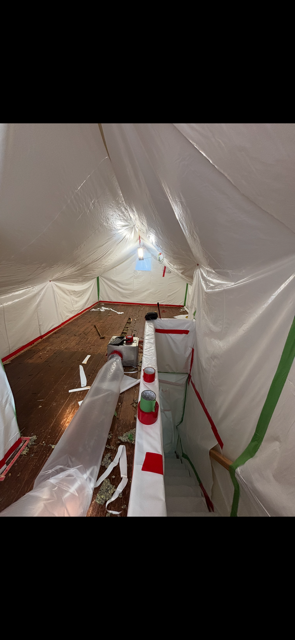
Abate it. Licensed removal involves containment, wet methods to keep fibers from becoming airborne during scraping, HEPA vacuuming, and post-abatement air clearance testing. After abatement, the ceiling surface can be refinished as desired.
DIY popcorn ceiling scraping is one of the most common causes of homeowner asbestos exposure. Dry scraping an asbestos-containing ceiling fills the room — and the HVAC system — with fibers. This is not a safe shortcut.
Philadelphia and Delaware County Context
In Philadelphia, renovation projects with alteration costs over $50,000 require an Asbestos Inspection Report before permit approval. Popcorn ceiling removal in a room renovation often brings a project over that threshold when combined with other work — making pre-project testing a permit requirement in many Philadelphia cases.
In Delaware County, PA DEP and L&I notification requirements apply when asbestos work crosses certain thresholds. A licensed contractor handles these notifications.
ACI-TECH, INC. performs asbestos testing and inspection and asbestos abatement for popcorn ceilings throughout Chester, Delaware County, and Philadelphia. If you’re planning a renovation and want to know what you’re dealing with first, call (610) 497-7162 or contact us online. For area-specific context on permit requirements and housing stock, see our guides for Chester, PA, Delaware County, PA, and Philadelphia, PA. Free estimates, seven days a week.