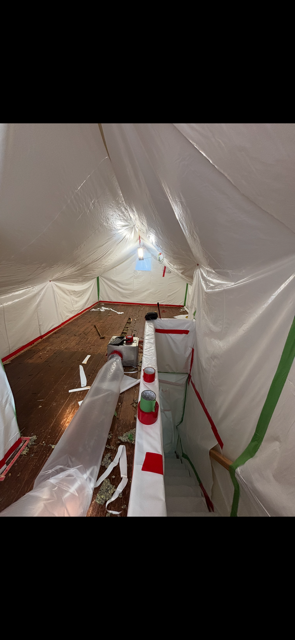
An asbestos inspection in a Delaware County home takes two to four hours and involves a licensed PA inspector visually surveying the property, collecting bulk samples from suspect materials, and submitting them to an accredited laboratory. Results typically come back in three to five business days. If materials test positive, you then decide between encapsulation, enclosure, or abatement — depending on material condition and your renovation plans.
This is how the process works, from the first phone call to the final report.
Who Can Legally Perform an Asbestos Inspection in Pennsylvania
In Pennsylvania, asbestos inspections must be performed by a certified Asbestos Inspector licensed by the Pennsylvania Department of Labor & Industry under the Asbestos Occupations Accreditation and Certification Act (Acts 194 and 161, 1990). This is separate from a general home inspector.
A PA-certified asbestos inspector has completed accredited training, passed a state exam, and must renew their certification periodically. When you call for an inspection, ask for the inspector’s current PA DL&I certification number. You can verify it through the PA Department of Labor & Industry.
A general home inspector can flag visually suspect materials and recommend testing — but only a certified asbestos inspector can take bulk samples and issue a formal asbestos inspection report.
Step 1: The Phone Consultation
Before the site visit, the inspector typically asks:
- Year the home was built
- What renovation work is planned (or whether this is a precautionary survey)
- Whether any materials are visibly deteriorating
- The size of the property
This helps determine the likely scope — how many samples will be needed and whether any areas require priority attention (a crumbling boiler room, for example, gets handled differently than floor tiles being assessed before a kitchen renovation).
Step 2: The Visual Survey
On-site, the inspector walks the entire property systematically, looking for materials that were manufactured during the asbestos-use era (roughly 1930–1980) and could contain asbestos. In a typical Delaware County row home or twin, this includes:
- Basement: Pipe insulation on steam or hot water lines, boiler or furnace insulation, floor tiles and adhesive, any duct wrap
- Kitchen: Floor tiles, vinyl sheet flooring, joint compound on walls or ceilings
- Bathrooms: Floor tiles, adhesive, drywall joint compound
- Throughout the home: Textured or acoustic ceiling finishes, plaster on older walls, window putty
- Attic: Vermiculite insulation (if present — associated with tremolite asbestos contamination)
- Exterior: Transite (asbestos-cement) siding or shingles if present
The inspector documents each suspect material, its location, estimated quantity, and physical condition — intact, damaged, or deteriorating.
Step 3: Bulk Sampling
For each suspect material, the inspector takes a small physical sample — typically a chip or plug of material no larger than a few square centimeters. The sampling process is minimally invasive:
- Pipe insulation: a small section of wrap is removed, usually at a joint or fitting
- Floor tiles: a small section is cut or a chip removed from a damaged or inconspicuous area
- Ceiling texture: a small scraping from a corner or inconspicuous location
Each sample is sealed in a labeled container, documented with location and description, and packaged for laboratory submission.
Sampling itself can release a small amount of fiber if the material is friable. A licensed inspector uses appropriate containment and cleanup procedures during sampling.
Step 4: Laboratory Analysis
Samples are submitted to an accredited laboratory — in Pennsylvania, labs accredited under the National Voluntary Laboratory Accreditation Program (NVLAP) or the American Industrial Hygiene Association (AIHA) are the standard. The standard analytical method is Polarized Light Microscopy (PLM), which identifies asbestos fiber types and estimates percentage by weight.
Results come back as:
- Positive — asbestos detected, with fiber type and percentage noted
- Negative — no asbestos detected
- Trace (<1%) — below the regulatory threshold but present
Standard turnaround is 3–5 business days. Rush analysis (24–48 hours) is available for an additional fee.
Step 5: The Inspection Report
The inspector issues a written report documenting:
- Every material sampled, its location, and its condition
- Laboratory results for each sample
- Whether any materials are regulated asbestos-containing materials (RACM) — generally defined as material containing more than 1% asbestos
- Recommendations for each positive material: manage in place, encapsulate, enclose, or abate
This report is what your contractor uses to plan abatement work. It’s also the document Philadelphia requires to be attached to demolition permit applications.
What Results Mean for Your Project
Negative results: Renovation can proceed without asbestos precautions for the sampled materials. Keep the report — it documents what was tested.
Positive, material in good condition, no planned disturbance: Manage in place. Document it, monitor it, and test again before any future renovation.
Positive, material in good condition, renovation planned: You have three options — encapsulation (approved coatings that seal the material), enclosure (building a new layer over it), or abatement (licensed removal). Your inspector can advise which is appropriate.
Positive, material deteriorating or friable: Priority abatement. Deteriorating asbestos-containing materials, especially pipe insulation, can release fibers without any physical disturbance.
What a Pre-Renovation Inspection Costs
Inspection fees vary with property size and number of samples required. A single-family row home in Chester or Delaware County typically requires 5–15 samples depending on materials present. ACI-TECH, INC. provides free on-site estimates before any inspection work begins — call (610) 497-7162 or contact us online.
If asbestos is found and abatement is needed, the inspection report is part of the abatement process. ACI-TECH handles both the inspection and abatement work, so you’re not managing two separate contractors. For area-specific detail on what inspectors typically find in Delaware County’s older boroughs, see our guides for Chester, Delaware County, Upper Darby, Lansdowne, and Collingdale.
Sources