The most common signs of mold in a basement are visible dark or discolored patches on walls or floor, a persistent musty odor, water stains or efflorescence on masonry, and peeling paint or bubbling drywall. These signs often appear together, but any one of them — especially a musty smell with no visible growth — is enough to warrant a closer look. Mold can be well-established before it becomes visible.
The Most Common Signs of Mold in a Basement
Visible growth is the most definitive sign, but mold colonies vary widely in appearance. Common presentations in basements include:
- Black or dark green patches on concrete block walls, particularly at the base of walls or corners where moisture accumulates
- Gray or white fuzzy growth on wood framing, rim joists, or stored materials
- Brown or green staining on drywall, ceiling tiles, or carpet backing
- Irregular dark spots that grow or change shape over weeks
Mold is not always the same color. The color of a colony is not a reliable indicator of the species or toxicity. The EPA recommends treating any visible mold growth as a problem worth addressing — the specific type matters less than its presence and the moisture source sustaining it.
A persistent musty odor without visible growth often indicates mold growing out of sight — behind finished walls, under carpeting, inside wall cavities, or in ductwork. If a basement consistently smells musty regardless of ventilation, hidden mold is more likely than not.
Water stains and efflorescence are indicators of chronic moisture intrusion rather than mold itself, but they mark the locations where mold is most likely to develop. Efflorescence — the white chalky mineral deposits that form on masonry as water moves through it — means water is moving through your foundation wall on a recurring basis. Wherever water moves through, mold conditions exist.
Worsening allergy or respiratory symptoms in household members who spend time in or near the basement — sneezing, congestion, or eye irritation that improves when away from home — can indicate airborne mold spores even when visible growth is limited. The CDC notes that mold exposure can trigger respiratory symptoms in sensitive individuals, and people with asthma or immune conditions are at elevated risk.
Why Pennsylvania Basements Are Especially Prone to Mold
Pennsylvania’s climate creates conditions that make basement mold a recurring problem rather than a one-time event.
Humidity cycles. Summers in the Delaware Valley bring prolonged periods of high humidity. Basements that are not actively conditioned or dehumidified accumulate moisture in the air that condenses on cooler masonry surfaces — enough sustained moisture to support mold growth without any obvious leak or flooding.
Freeze-thaw cycling. Pennsylvania winters put significant stress on foundation walls and window wells. Water that penetrates masonry cracks and refreezes expands those cracks incrementally each winter. Over years, this creates persistent pathways for water intrusion that aren’t visible from the interior until mold or efflorescence appears.
Older housing stock. The Delaware Valley’s housing stock skews old — a significant portion of homes in Chester, Delaware County, and Philadelphia were built before 1950. Older homes have fieldstone or unreinforced concrete block foundations without modern waterproofing membranes. These foundations are permeable to moisture by design — they were built in an era when basements were expected to be damp. Modern expectations for dry, finished basements conflict directly with how these foundations were constructed.
High water tables in low-lying areas. Parts of Delaware County and Chester sit near the Delaware River and its tributaries. Seasonal high water tables in these areas push groundwater against foundation walls from the exterior, which no amount of interior dehumidification fully addresses without proper drainage and waterproofing.
Is Mold Always Visible?
No. Mold grows wherever moisture and an organic food source are present. In basements, this includes locations that are routinely concealed:
- Behind finished drywall. A finished basement wall with any history of moisture intrusion may have an active mold colony on the back face of the drywall — the paper backing is an excellent food source — while the painted front face shows no growth at all. The first visible sign is often paint that bubbles, peels, or discolors.
- Under carpet and padding. Basement carpet that has experienced any moisture — whether from flooding, condensation, or slow seepage — often develops mold on the backing or in the foam padding before the carpet surface shows any change.
- In HVAC ductwork. If supply or return ducts run through a basement with high humidity or a past moisture event, mold can establish inside ductwork and circulate spores throughout the house. This is a mechanism for mold exposure with no visible source in the living space.
- In rim joists and sill plates. The wood framing where floor joists meet the foundation is a high-moisture zone in many older basements. Mold in rim joists is common and often discovered during renovation or inspection.
If you have chronic musty odors with no visible mold, or if a past water event occurred in a finished basement, professional mold assessment — not just a visual check — is the appropriate next step.
DIY vs. Professional Remediation
Surface mold on a small, isolated, non-porous area — a few square feet of concrete block with no sign of hidden growth — can be cleaned with appropriate protective equipment and an EPA-registered biocide. The EPA’s guidance on mold cleanup suggests that small areas of mold (roughly 10 square feet or less) can be addressed by a homeowner with appropriate precautions, provided the moisture source is already fixed.
Professional remediation is required when:
- Growth exceeds 10 square feet in total area, regardless of how the area is distributed
- Growth is present on porous structural materials — wood framing, drywall, insulation — where surface cleaning is not sufficient
- The moisture source is unresolved, which means the problem will return
- Mold is suspected inside HVAC systems, which can distribute spores building-wide during the remediation process
- An immunocompromised person, infant, or individual with asthma is in the household
- A pre-sale inspection has flagged mold, and you need documented clearance testing for the transaction
DIY attempts on large or hidden mold problems typically spread spore counts rather than reduce them, because disturbing a colony without proper containment releases spores into the air. A professional remediation includes containment, HEPA filtration during work, and post-remediation air or surface testing that confirms work is complete. That documentation matters both for your family’s health and for any future real estate transaction.
One practical note for pre-1978 Pennsylvania basements: before remediating basement mold that is adjacent to floor tiles, pipe insulation, or ceiling tiles, confirm whether those materials contain asbestos. In older Delaware Valley homes, these materials often do. Disturbing asbestos-containing materials during mold remediation without proper sequencing creates a second, more serious hazard. ACI-TECH handles both — and when both are present, we sequence the work correctly.
What Professional Mold Remediation Involves
A professional mold remediation in a Pennsylvania basement follows a consistent sequence:
1. Assessment. Before work begins, the scope of growth is documented — visual inspection, moisture readings, and air or surface sampling where the extent of hidden growth is uncertain. Identifying the moisture source is part of the assessment, not something left to the homeowner to figure out afterward.
2. Moisture source correction. Remediation without fixing the water source is temporary. If a foundation crack, failing window well drain, or HVAC condensation issue is feeding the mold, that gets addressed — or at minimum confirmed as resolved — before remediation work begins.
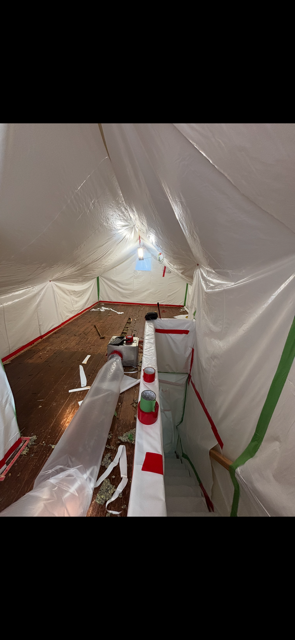
3. Containment. The affected area is isolated with plastic sheeting and negative air pressure to prevent spores from migrating to the rest of the house during work.
4. Removal. Mold-affected materials that cannot be adequately cleaned — drywall, carpet, insulation, wood framing with deep penetration — are removed and properly bagged for disposal. Non-porous surfaces are HEPA-vacuumed and cleaned with an EPA-registered biocide.
5. Post-remediation verification. Air or surface sampling after work confirms that spore counts have returned to normal levels. This is the step that produces documentation — a clearance report confirming successful remediation.
If you’re seeing signs of mold in your Pennsylvania basement, the earlier you address it, the smaller the scope. Most mold problems that reach the point of significant structural involvement started as something that would have been straightforward to remediate months earlier.
ACI-TECH, INC. provides mold remediation throughout Chester, Delaware County, and the greater Delaware Valley. For a free estimate, call (610) 497-7162 or contact us online.
Sources