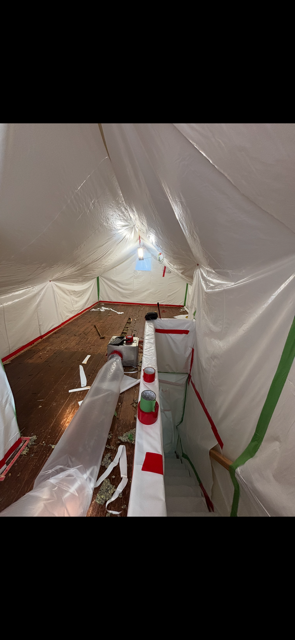
Asbestos abatement in Upper Darby, PA typically involves the same materials found throughout Delaware County’s pre-war brick twin stock — steam pipe insulation, floor tiles, and mid-century renovation compound — but the township’s pre-sale certification requirements mean that abatement before closing is increasingly standard. This post documents a whole-house project in a 1938 twin where positive findings across three material types required containment in five separate areas before the property could transfer.
What Asbestos Testing Found in a 1938 Upper Darby Brick Twin
The home was a two-story brick twin built in 1938 — the peak era for asbestos-containing building materials in Upper Darby and the surrounding Delaware County municipalities. A PA-certified asbestos inspector collected bulk samples before the sale. Results came back positive on three material types:
- Steam pipe insulation in the basement — the original wrap from installation, friable and deteriorating at the elbows
- 9×9 vinyl floor tiles in the kitchen and basement, along with the black mastic adhesive beneath them
- Joint compound on walls in two upstairs rooms, applied during a mid-century renovation
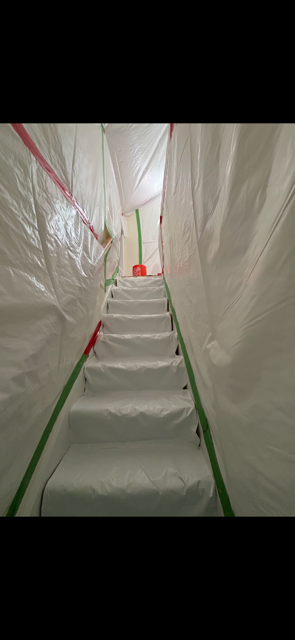
With positive findings across the basement and two floors, the asbestos abatement scope required containment in five separate areas: bedroom, closet decon chamber, hallway, staircase, and basement.
What Full-House Asbestos Abatement Containment Looks Like
Asbestos abatement in Upper Darby row homes and twins requires isolating each work area completely from the rest of the house. ACI-TECH established negative-pressure containment in every affected area before any material was disturbed.
Bedroom: Full poly enclosure floor to ceiling — walls, windows, and ceiling vent sealed. A HEPA negative-air unit ran continuously, maintaining negative pressure so air flows into the work area rather than out. This prevents asbestos fiber migration into adjacent rooms during abatement.
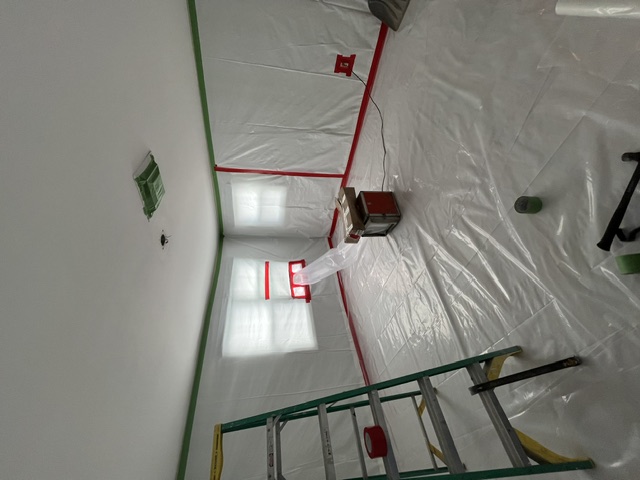
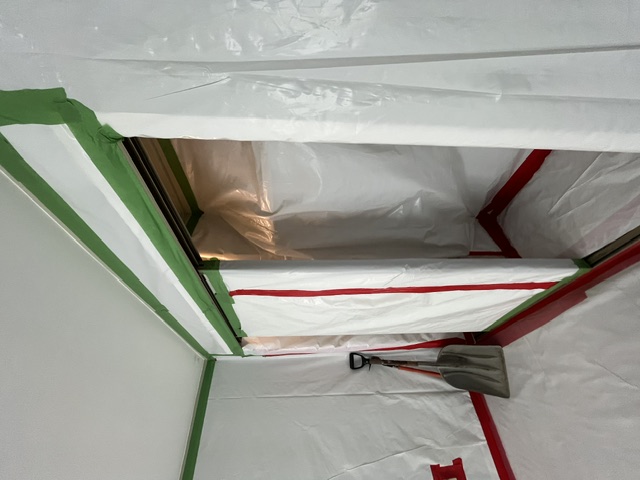
Decontamination airlock: The closet entry served as the decon chamber — the transition zone where workers remove and bag contaminated PPE before exiting containment. Overlapping poly flaps create an airlock so the barrier is never fully open during work.
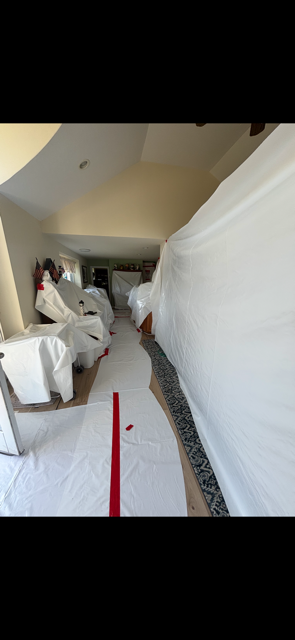
Hallway: The full length of the hallway was sealed with poly sheeting, furniture wrapped, floor covered. In a two-story twin, the hallway is the contamination pathway connecting every room — a containment breach here spreads asbestos fibers throughout the home.
Staircase: Full bilateral containment — poly sheeting from floor to ceiling on both sides, stair treads covered. The staircase connects the basement pipe work area to the upper-floor joint compound areas, making it the highest-risk passage in the project.
Asbestos Abatement Process and Air Clearance
Abatement involved wet removal of the pipe insulation at all basement runs and elbows, wet-scraping of floor tiles and mastic, and controlled removal of the joint compound sections in the two upstairs rooms. All material was double-bagged in labeled 6-mil poly bags, manifested as regulated asbestos waste, and transported to a PA DEP-permitted disposal facility.
Post-abatement air clearance testing by a third-party inspector confirmed fiber concentrations below Pennsylvania clearance standards in all five work areas. The sellers received a full documentation package — PA L&I notification filing, air clearance certificates, and waste disposal manifests — to provide at closing.
The property transferred on schedule.
Asbestos Abatement in Upper Darby: Why Timing Matters
Upper Darby Township has the highest documented childhood lead poisoning rate in Delaware County and has passed ordinances requiring pre-sale property certifications. Pre-sale asbestos abatement in Upper Darby requires planning: PA L&I requires 5 working days advance notification before abatement begins, and post-abatement air clearance testing must pass before the space is released. On a whole-house scope, that timeline needs to be built into the transaction calendar — not discovered two weeks before closing.
ACI-TECH handles all PA DEP and PA L&I notification filings as part of every asbestos abatement project in Upper Darby and throughout Delaware County. Contact us for a free estimate, or see our asbestos abatement and asbestos testing pages.
Sources