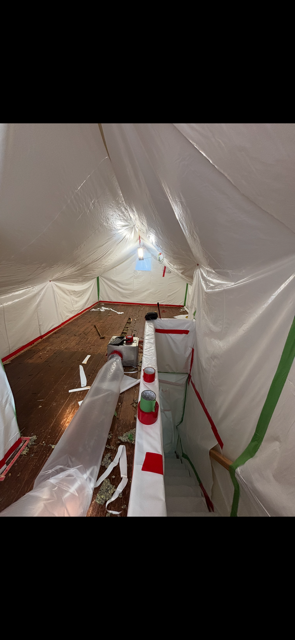
Philadelphia’s pre-1978 residential housing stock almost certainly contains asbestos-containing materials somewhere in the structure — and the city’s own regulatory requirements reflect that reality directly. The Philadelphia Department of Public Health estimates that approximately 95% of pre-1978 housing in Philadelphia may contain asbestos, across an estimated 520,000 residential units.
For a city where roughly 78% of housing was built before 1980, that is not a narrow edge case. It is the norm.
Why Philadelphia’s Housing Age Makes Asbestos Nearly Universal in Pre-1980 Stock
Asbestos was used in American residential construction in a predictable pattern tied almost entirely to construction date:
- Pre-1930: Asbestos increasingly used in industrial and steam-heated buildings; residential use begins with pipe insulation and plaster
- 1930–1945: Widespread adoption in residential materials — pipe wrap, floor tiles, roofing, plaster board
- 1945–1975: Peak residential use; 9×9 vinyl-asbestos floor tiles were standard, acoustic spray coatings common, joint compound widely used
- Post-1975: The EPA restricted spray-applied asbestos in 1973, asbestos pipe wrap for new residential construction in 1975, and asbestos-containing patching compounds in 1977. Production of asbestos floor tiles effectively ended in the early 1980s.
Philadelphia’s row homes were built in waves that land squarely in the middle of this risk window. North Philadelphia, West Philadelphia, Kensington, and South Philadelphia are dense with brick row homes built between 1900 and 1940. Pre-war housing in these neighborhoods frequently contains steam pipe insulation, early plaster with asbestos fiber, and original flooring installed during mid-century renovations. Northeast Philadelphia and the city’s outer neighborhoods added heavily in the 1950s and 1960s — the period when asbestos floor tiles and acoustic ceiling products were at peak use.
The Most Common Asbestos-Containing Materials in Philadelphia Row Homes by Era
1900–1940 row homes (North Philly, West Philly, Kensington, South Philly):
- Steam pipe insulation — coal-fired steam heat was standard; the pipe runs throughout these buildings were wrapped in asbestos insulation, often original and still in place
- Early asbestos-containing plaster — asbestos fiber was added to exterior stucco and finish plaster for durability
- Roofing materials — asbestos-containing roofing felts and shingles were common through the 1930s
1940–1965 construction or mid-century renovation:
- 9×9 vinyl-asbestos floor tiles — nearly universal in kitchens, bathrooms, and basements; the black mastic adhesive beneath them also typically contains asbestos
- Transite (asbestos-cement) flue pipes — connecting furnaces and boilers to chimneys; found in many Philadelphia row homes with updated HVAC systems
- Acoustic ceiling tiles — asbestos-containing tiles were standard in finished basement rooms and commercial-use ground floors
1965–1980 construction:
- 12×12 floor tiles — also frequently contain asbestos; the tile size changed, the material often did not
- Textured “popcorn” ceiling spray — spray-applied acoustic finishes were popular and commonly contained asbestos; the EPA banned asbestos in spray-applied surfacing materials in 1973, but pre-existing applications remained
- Joint compound — asbestos was used in drywall joint compound through the mid-1970s; homes finished or renovated in this period may have it on every wall
The Party Wall Problem in Dense Rowhouse Neighborhoods
Philadelphia’s row homes share party walls — the masonry walls between adjoining properties. This creates a specific hazard during renovation that does not exist in detached housing.
When asbestos-containing materials are disturbed during renovation, fibers become airborne. In a detached house, the exposure pathway is contained within the unit being worked on. In a row home with shared walls, basement connections, or common heating systems, disturbed asbestos fibers can migrate to adjacent units through gaps in wall penetrations, shared basement spaces, or connected duct systems.
This is not a theoretical concern. It is the reason Philadelphia requires contractor notification and permitting above certain thresholds — and why professional containment procedures matter more in row home neighborhoods than they do in suburban construction.
When Professional Testing Is Legally Required in Philadelphia
Philadelphia’s Department of Licenses and Inspections (L&I) adds requirements beyond Pennsylvania state minimums:
- Demolition permits will not be approved without an Asbestos Inspection Report attached — unless the building was constructed after December 31, 1980, or is a residence with three or fewer units
- Renovation projects with alteration costs exceeding $50,000 require an Asbestos Inspection Report from a city-licensed asbestos investigator before permits are issued
- Removal or encapsulation of 40 or more linear or square feet of asbestos-containing material requires an asbestos abatement permit from Philadelphia L&I before work begins, with a 10-working-day advance notification
The $50,000 alteration threshold is lower than it sounds in Philadelphia’s current renovation market. A full kitchen renovation, a bathroom gut, or a basement conversion in a pre-war row home routinely crosses that line. A contractor who does not disclose this requirement — or who pulls permits without attaching an inspection report — is putting both the homeowner and themselves in violation.
When testing is strongly recommended even if not legally required:
Any renovation that involves removing flooring, opening walls, disturbing pipe insulation, replacing a boiler, or working on a roof in a pre-1980 Philadelphia home carries real exposure risk if the materials are not first characterized. A pre-renovation asbestos inspection is the correct first step regardless of whether the regulatory thresholds are technically met.
What This Means for Row Home Owners
If you own or are buying a pre-1980 Philadelphia row home, the data says asbestos-containing materials are more likely present than not. That is not a crisis in itself — intact, undisturbed asbestos poses no airborne fiber risk. But it is a condition that must be known before any renovation work begins.
The most common source of asbestos exposure for Philadelphia homeowners is not asbestos sitting in place — it is asbestos disturbed during tile removal, pipe replacement, basement finishing, or renovation work carried out without knowing what was present.
Before any renovation project in a pre-1980 Philadelphia row home, the sequence is straightforward:
- Have a licensed asbestos inspector sample suspect materials before any work starts
- If asbestos is found, retain a PA-certified abatement contractor to handle removal before other work proceeds
- Confirm whether Philadelphia L&I permits and an Asbestos Inspection Report are required for your project scope
ACI-TECH, INC. is based in Chester and serves Philadelphia and the surrounding region. Contact us for a pre-renovation asbestos inspection or call (610) 497-7162. If testing confirms asbestos, we handle asbestos abatement and asbestos removal as well. For a complete overview of Philadelphia’s asbestos and lead permit requirements and housing risks, see our Philadelphia asbestos and lead remediation guide. Free estimates available.
Sources