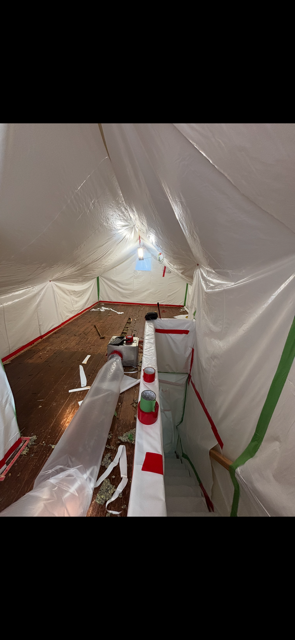
Asbestos floor tile removal in a Delaware County basement starts with one question: did you test before the renovation contractor touched the floor? In a 1952 row home with original 9×9 vinyl tiles, the answer to whether they contain asbestos is almost always yes — but the only way to know for certain, and to document it for PA compliance, is bulk sampling before demolition begins.
Why 9×9 Floor Tiles in Delaware County Basements Are High-Risk for Asbestos
The DVRPC documents that over 57% of Delaware County’s housing units were built before 1960 — placing the majority of the county’s row home and twin stock squarely in the era when asbestos vinyl floor tiles were the standard residential product. 9×9 inch vinyl floor tiles manufactured from the late 1940s through the early 1980s were produced with chrysotile asbestos as a reinforcing fiber, typically at 15–25% by weight. The black mastic adhesive used to set them also commonly contains asbestos.
This home — a 1952 row home in Delaware County — had its original checkerboard basement floor untouched since installation. Before any demolition work began, ACI-TECH collected bulk samples of both the tile and the black mastic adhesive and sent them to an NVLAP-accredited laboratory.
Both tested positive: chrysotile asbestos in the tile at approximately 3% by weight, and positive in the mastic as well. A positive result on a 1952 Delaware County basement floor is expected, not unusual — it is the norm for homes from this era.
Asbestos Containment Setup for Basement Floor Tile Removal
Before any tile was disturbed, ACI-TECH established full poly containment in the basement: walls sealed floor to ceiling with poly sheeting, red tape at the baseboard perimeter, HEPA negative-air unit running to maintain negative pressure. The regulated waste collection bag — a large FIBC bulk bag on a wheeled pallet — was staged inside containment so no bagged asbestos waste traveled through the living space.
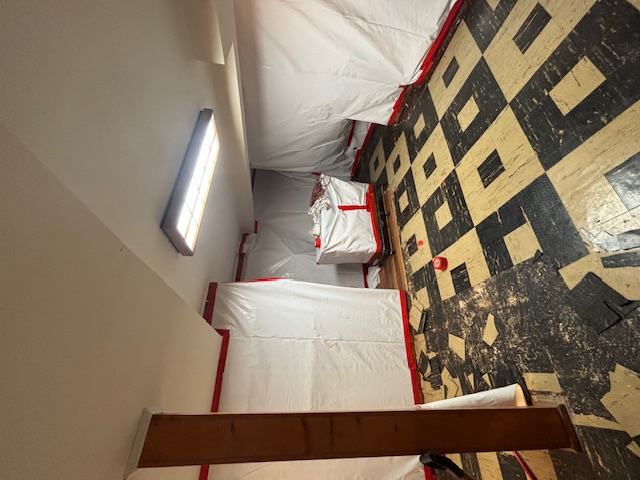
Tiles were wet-scraped using hand tools — no grinding, no power chipping, no dry removal. Wet methods suppress airborne fiber release during asbestos tile removal. Each tile section went directly into the sealed waste bag inside containment.
After Asbestos Floor Tile Removal: What the Subfloor Looks Like
After all tiles and mastic were removed and bagged, the subfloor was HEPA-vacuumed and wet-wiped. Post-abatement air clearance testing confirmed fiber concentrations below Pennsylvania clearance standards.
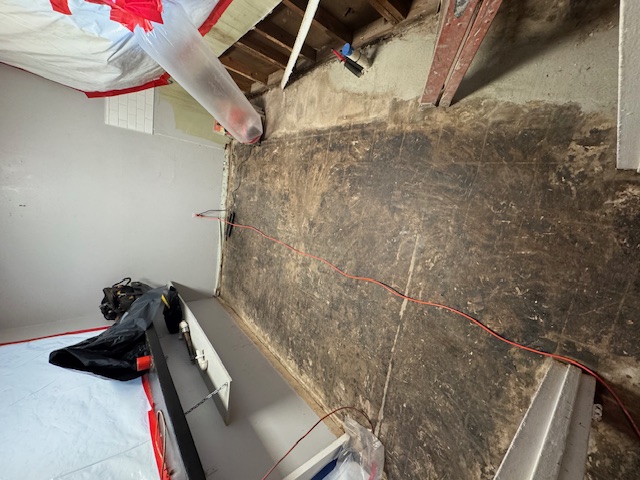
The dark staining visible on the slab is mastic residue — normal after asbestos tile removal and not an ongoing hazard. The residue is encapsulated and poses no fiber release risk; the renovation contractor can pour a new slab or install new flooring directly over it once ACI-TECH’s air clearance certificate is issued.
Asbestos Floor Tile Testing and Removal in Delaware County — The Right Sequence
A renovation contractor who dry-chips or grinds 9×9 tiles without asbestos testing first creates an uncontrolled asbestos exposure event. The homeowner is in the house. The workers have no respiratory protection. Waste ends up in a dumpster without proper disposal documentation. All of it is avoidable with a bulk sample test before the first tool touches the floor.
ACI-TECH provides asbestos testing with 2–3 day lab turnaround throughout Delaware County. If tiles test positive, we schedule asbestos removal before the renovation contractor starts demolition. Contact us for a free estimate — call (610) 497-7162 or reach us online.
Sources