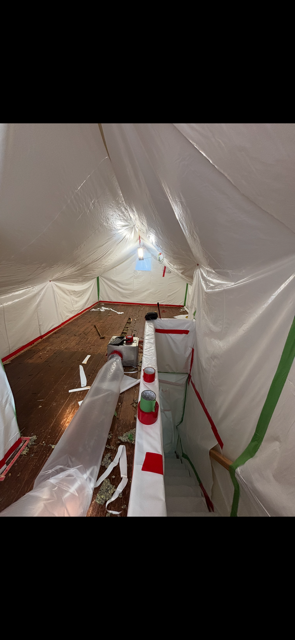
If your Chester row home has a steam boiler and original pipe insulation, asbestos is almost certainly present. Steam heat was the heating standard in the brick row homes built across Chester between 1900 and 1940, and the pipe insulation used in that era was asbestos — applied as wrap, block insulation, and cement on elbows and fittings. In a home that hasn’t had its basement pipes disturbed, that original insulation is likely still there.
Why Steam Systems Are the Highest-Risk Location in Pre-1940 Chester Homes
Asbestos was the material of choice for steam pipe insulation for straightforward reasons: it doesn’t burn, it holds up under repeated high temperatures, and it was cheap and widely available. Every steam supply line, every elbow, every fitting, and the boiler jacket itself was insulated with it in residential construction during the pre-war decades.
The EPA documents that asbestos insulation was used in residential boilers and piping through the 1970s, though the materials in Chester’s 1900–1940 row homes predate the mid-century products by decades. Unlike floor tiles or ceiling finishes — which required active renovation to introduce — steam pipe insulation was built in from day one and never replaced unless there was a pipe failure or a full system conversion.
Chester’s housing stock makes this relevant at scale. The vast majority of the city’s residential units predate 1950, and steam heat was the dominant system in that construction era. That means the basement of a 1920s Chester row home is among the most likely single locations in Delaware County to contain in-place asbestos insulation.
What Asbestos Pipe Insulation Looks Like
Asbestos pipe insulation in a Chester basement typically appears in a few forms:
Wrap insulation on straight runs: A gray or white fibrous wrap applied directly to supply lines. In intact condition it may look like a firm, smooth surface. Where it has degraded, it becomes soft, powdery, or visibly crumbling — this is called friable material, and it can release fibers without being mechanically disturbed.
Corrugated or block sections at elbows and fittings: Fittings and elbows were harder to wrap continuously, so pre-formed block or corrugated sections were used at bends and joints. These sections are often visibly different from the straight-run wrap — slightly rougher, sometimes with plaster-like outer coating.
Boiler jacket: The exterior covering of the boiler unit itself was often an asbestos-containing insulating jacket. Some boiler jackets were removed during system replacements; others are still in place around older equipment.
Canvas or cloth outer layer: Many installations have a canvas or cloth wrap over the asbestos layer, which was used as a protective outer covering. Seeing canvas on your pipes doesn’t rule out asbestos underneath — it often indicates it.
You cannot identify asbestos by appearance alone. Visual inspection can identify suspect materials; only laboratory analysis of a physical sample confirms the presence and percentage of asbestos.
Friable vs. Intact — Why Condition Determines Risk
Intact asbestos-containing materials that are not disturbed do not pose an elevated health risk in ordinary circumstances. The EPA’s guidance on asbestos in the home is explicit on this: asbestos that is in good condition and is not disturbed should be left alone and monitored.
The risk arises from fiber release. When asbestos-containing insulation is disturbed — cut, scraped, removed, or simply crumbling on its own — it releases microscopic fibers that remain airborne and can be inhaled. The OSHA permissible exposure limit for asbestos is 0.1 fibers per cubic centimeter averaged over an 8-hour workday — a standard that cannot be measured by eye. It requires air monitoring.
For Chester homeowners, the practical implication is this: if your pipe insulation is visibly damaged, powdery, or crumbling, it is actively releasing fibers without being touched. That condition warrants priority abatement, not monitoring. If it appears intact and dry, monitoring and documentation are appropriate until renovation creates a need to act.
What Pennsylvania Requires Before Any Pipe or Boiler Work
You cannot legally replace a steam boiler or disturb pipe insulation in a pre-1980 Pennsylvania home without addressing the asbestos question. Pennsylvania L&I regulations under Acts 194 and 161 require that any licensed contractor performing asbestos abatement provide 5-day prior notification to the department before any friable asbestos project above 3 linear or 3 square feet.
Projects above federal NESHAP thresholds — 260 linear feet, 160 square feet, or 35 cubic feet — require a 10-working-day advance notice to PA DEP.
The practical implication for a Chester homeowner replacing a boiler or converting from steam to forced air: the HVAC contractor cannot legally remove asbestos-containing pipe insulation. That work must be performed by a licensed asbestos abatement contractor, with required notifications filed, before the HVAC crew begins. A homeowner who hires an unlicensed crew to pull out pipe insulation as part of a boiler replacement is generating asbestos exposure in their home and in their neighborhood — and is not complying with state law.
The Row Home Party Wall Problem
Chester’s row home density adds a complication that doesn’t apply to detached housing. Steam supply lines in a row home often run horizontally along basement party walls before rising to upper floors. If those pipes run against a shared wall with the adjoining unit — and the insulation on them is friable — disturbance on your side of the wall can affect air quality on your neighbor’s side as well.
This matters during abatement planning. A licensed abatement contractor working on party-wall pipes in a Chester row home needs to account for containment that protects both units.
When to Call a Licensed Inspector Before Touching Anything
Before any of the following work on a pre-1980 Chester home, the correct first step is an inspection by a PA-certified asbestos inspector:
- Boiler replacement or steam-to-forced-air conversion
- Any pipe repair or replacement in the basement
- Full basement finishing
- Removal of the old boiler or hot water heater
- Any demolition that requires opening walls near steam lines
A licensed inspector will visually survey the materials, collect physical samples from suspect insulation, and submit them to an accredited laboratory. Results come back in three to five business days and produce a written report that tells you exactly which materials are asbestos-containing, their condition, and what remediation is required. That report is what the abatement contractor uses to plan the work and file the required PA L&I notification.
ACI-TECH, INC. is based at 2300 W. 4th Street in Chester — we work in Chester’s row home basements every week. Contact us for an asbestos inspection or call (610) 497-7162 before any pipe or boiler work begins. If testing confirms asbestos, we handle asbestos abatement and asbestos removal of the pipe insulation before your HVAC contractor begins. For a broader look at asbestos and lead paint risks throughout Chester’s housing stock, see our Chester, PA asbestos and lead remediation guide. Free estimates available Monday through Saturday, 7 AM to 9 PM.
Sources