Lead-based paint is present in the vast majority of Chester homes, because virtually every residential unit in the city was built before the federal Consumer Product Safety Commission banned lead in residential paint in 1978. In homes built before 1940 — which describes most of Chester’s brick row home stock — lead paint was applied to virtually every painted surface: interior walls, trim, doors, windows, and exterior facades. The age of Chester’s housing makes this a near-universal condition, not an isolated risk.
Why Chester’s Housing Age Creates a City-Wide Lead Risk
The Delaware County Health Department estimates that 80% of county homes contain lead-based paint and documents over 300 children poisoned annually across the county. Chester sits within that risk tier, with a housing stock that is among the oldest in Delaware County — the dense brick row homes between Edgmont Avenue and the waterfront were built predominantly between 1900 and 1940, a period when lead paint was the industry standard for interior and exterior application.
Lead paint on intact surfaces in good condition does not pose an immediate risk to adults. The risk concentrates in two situations: deteriorating paint that chips, peels, or chalks into dust, and renovation activity that sands, scrapes, or cuts through painted surfaces, generating fine lead dust. Both conditions are common in Chester’s older housing stock.
Children Under 6: The Highest-Risk Group
The CDC is explicit that there is no safe level of lead exposure for children. Lead affects neurological development — cognitive function, attention, and behavior — at levels too low to produce visible symptoms. Young children are disproportionately exposed because they put their hands in their mouths and spend time on floors where lead dust settles.
The CDC’s childhood blood lead reference value — the level at which public health action is recommended — is 3.5 micrograms per deciliter (µg/dL), reduced from 5 µg/dL in 2021. Pennsylvania’s childhood lead surveillance program through the Department of Health requires reporting of blood lead levels at or above 3.5 µg/dL in children under 16, and requires follow-up investigation and case management at elevated levels.
Pennsylvania also requires blood lead screening for all children at ages 1 and 2, and for children ages 3–6 who have not previously been tested. If you have a child under 6 in a Chester home and have not had them tested, talk to your pediatrician.
What Happens to Lead Paint During Renovation
The most common way lead exposure occurs in Chester homes is not from intact old paint — it’s from renovation. Sanding, scraping, or cutting through painted surfaces in a pre-1978 home generates fine lead dust that settles on floors, countertops, and toys, and can remain in a home for weeks after the work is done.
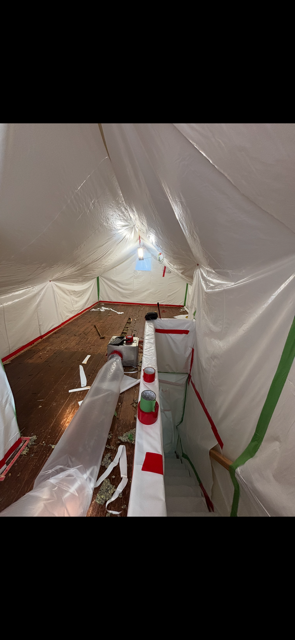
The EPA’s Renovation, Repair, and Painting (RRP) Rule requires any contractor working on pre-1978 homes — performing work that disturbs painted surfaces greater than 6 square feet per room indoors or 20 square feet outdoors — to be certified as an RRP Lead-Safe Firm and use lead-safe work practices. These include wet methods to minimize dust, containment to prevent spread, and post-work cleanup and verification.
Before hiring any contractor for work in a pre-1978 Chester home, ask for their EPA RRP firm certification number. You can verify firms in the EPA’s RRP certification search. An unlicensed crew sanding floors or replacing windows in a Chester row home without lead-safe practices can contaminate a home that was previously safe for children.
Lead Inspection vs. Lead Risk Assessment: Two Different Things
These terms are sometimes used interchangeably, but they’re distinct processes with different outputs.
A lead inspection identifies the presence and location of lead-based paint throughout a property, testing every painted surface. It answers: “Where is lead paint present, and how much?” A lead inspection does not assess whether the paint poses a hazard — it documents presence.
A lead risk assessment evaluates hazardous conditions — deteriorating paint, lead dust, and lead in soil — and produces a report identifying specific hazards and recommended actions. It answers: “What lead hazards exist in this property right now, and what do I need to do about them?”
For homeowners with young children in a Chester row home showing any paint deterioration — peeling, chipping, chalking — a risk assessment is the more actionable starting point. For homeowners selling a pre-1978 property, a lead inspection provides documentation of known conditions, which is relevant to the federal disclosure requirements described below.
Federal Disclosure Requirements for Sellers
Federal law (42 U.S.C. § 4852d) requires sellers of pre-1978 residential properties to disclose known lead hazards and provide buyers with the EPA and HUD lead hazard information pamphlet (“Protect Your Family from Lead in Your Home”). Pennsylvania does not require testing before sale, but disclosure of known lead conditions is mandatory — and failure to disclose can create significant legal liability.
A pre-sale lead inspection removes the uncertainty and documents what is present, giving buyers accurate information and sellers a clear disclosure record.
Financial Assistance Available for Chester Homeowners
Delaware County’s Lead Hazard Control Program provides financial assistance to qualifying low-income homeowners who have a child aged 5 or under. Eligible households receive hazard reduction work — including window and door replacement, drywall installation over deteriorated surfaces, and replacement of painted trim and moldings — at no cost. Work is performed by certified lead abatement contractors. To apply, contact the Delaware County Health Department directly or visit the leadfree123 program page.
Chester’s proximity to county services means ACI-TECH can often coordinate with the Delaware County program and with homeowners navigating the application and inspection process at the same time.
The Practical Next Step
If you have young children in a Chester row home, or if you’re planning any renovation that will disturb painted surfaces, the practical first step is a lead risk assessment. It identifies the hazards present, tells you what needs to be addressed, and produces documentation that is useful for the county assistance application, for real estate transactions, and for your own records.
ACI-TECH, INC. is licensed for lead remediation work in Pennsylvania and is based at 2300 W. 4th Street in Chester. Learn more about our lead remediation services or call (610) 497-7162 to schedule a free on-site estimate. For a complete overview of Chester’s asbestos and lead paint risks — including the Sun Shipbuilding history, steam pipe insulation, and Delaware County financial assistance programs — see our Chester, PA asbestos and lead remediation guide. Available Monday through Saturday, 7 AM to 9 PM.
Sources
- EPA — Lead Paint History and Use
- EPA — Renovation, Repair, and Painting Program
- CDC — About Lead Exposure in Children
- CDC — Childhood Blood Lead Data
- PA Department of Health — Lead Poisoning Prevention
- HUD — Lead Paint Disclosure Requirements
- Delaware County Health Department — Lead Hazard Control Program