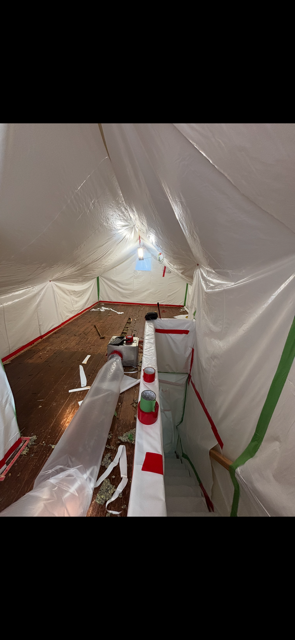
The three places you’re still most likely to find asbestos in Delaware County and Philadelphia are: pre-1980 homes (basements, kitchens, and mechanical systems), older commercial and institutional buildings (schools, office buildings, multi-unit housing), and aging steam and hot water heating systems. You cannot confirm asbestos by sight — laboratory testing of a physical sample is required — but knowing these categories tells you when to test before any renovation work begins.
The EPA’s 1989 partial ban was largely overturned by the Fifth Circuit Court of Appeals in 1991, and while new uses are now heavily restricted, asbestos-containing materials installed before that period remain in place throughout the Delaware Valley’s pre-war housing stock.
1. Pre-1980 Homes
Delaware County has an unusually high concentration of pre-war housing — the DVRPC documents that over 57% of the county’s housing units were built before 1960, and many of Chester’s row homes predate 1940. The specific renovation triggers that bring people face-to-face with asbestos in these homes follow predictable patterns.
The basement mechanical room is the highest-risk discovery zone. Most Delaware County row homes from the 1920s through the 1950s were heated by steam, and the pipe distribution system running from boiler to radiator was wrapped in asbestos insulation at installation. This insulation is often still the original material — and in many homes, it has never been tested or disclosed. A contractor replacing a boiler in a 1935 Chester row home is working directly alongside this material. So is a plumber touching the supply lines, or a homeowner finishing a basement.
Kitchen and bathroom floors are the second most common discovery. The 9×9 tile standard from roughly 1947 to 1981 is so widely distributed in Delaware County kitchens and bathrooms that testing is essentially routine before any floor removal. This applies equally to the black mastic adhesive beneath the tiles.
Attic work and ceiling renovations surface a third category. Spray-applied textured ceiling finish, vermiculite attic insulation, and old joint compound on walls are less visible than pipe wrap or floor tiles but appear regularly during renovation scoping. For a detailed breakdown of what each asbestos-containing material type looks like and how risk varies by material, see the different types of asbestos materials in pre-1980 homes.
If your home was built before 1980 and you’re planning work that will disturb existing materials — floors, ceilings, walls, or mechanical systems — asbestos testing by a PA-certified inspector is the right first step.
2. Older Commercial and Institutional Buildings
Asbestos was also standard in commercial and public building construction through the late 1970s. Older office buildings, schools, churches, multi-unit residential buildings, and retail spaces in the Philadelphia area may contain asbestos in:
- Vinyl floor tiles and sheet flooring
- Pipe and boiler insulation
- Spray-applied fireproofing on structural steel
- Ceiling tiles
- Roofing materials
- HVAC duct insulation and wrap
In Pennsylvania, commercial demolition and renovation projects that will disturb regulated asbestos-containing material above certain thresholds require prior notification to PA DEP and must be performed by a licensed abatement contractor. Building owners and property managers who plan renovation work in pre-1980 commercial buildings should have a pre-renovation asbestos survey conducted by a PA-certified asbestos inspector before any work begins.
The EPA’s NESHAP regulations (40 CFR Part 61 Subpart M) govern demolition and renovation projects involving asbestos and apply to commercial properties regardless of the quantity involved in a full demolition.
3. Aging Mechanical Systems
Heating systems are overlooked because homeowners often don’t think of a boiler room as a renovation — it’s maintenance, not remodeling. But a boiler replacement in a 1930s Chester or Collingdale row home almost always involves the pipe insulation directly adjacent to the boiler, and that insulation may be original from the home’s construction.
This is the scenario where unintentional asbestos disturbance happens most often in Delaware County: a plumber or HVAC contractor removes an old boiler, cuts or shifts the pipe connections, and disturbs deteriorating pipe wrap without anyone having tested it first. The homeowner hasn’t renovated the basement. No permits were pulled for asbestos. The work is routine maintenance. But the fiber release is real.
Forced-air systems in postwar homes carry a different version of this problem. Duct connections near the furnace were sometimes sealed with asbestos tape and wrapped with asbestos duct insulation in the 1950s and 1960s. This material is not visible unless someone opens the mechanical room, and it is frequently intact until the first HVAC service call in decades.
The practical rule: before any heating contractor works on a system in a pre-1980 home — boiler replacement, furnace swap, duct repair — have a PA-certified asbestos inspector assess the insulation and connections first. This is the simplest way to prevent an unplanned asbestos exposure from becoming an insurance and liability situation for everyone involved.
Anyone planning to replace, repair, or disturb an older heating system or HVAC equipment in a pre-1980 building in Pennsylvania should treat all insulation and wrap as potentially asbestos-containing until tested.
ACI-TECH, INC. provides licensed asbestos inspection and testing for homes and commercial properties in Chester, Delaware County, and the Philadelphia area. If materials test positive, we provide licensed abatement under proper containment. Call (610) 497-7162 for a free estimate before any renovation work.