You cannot identify asbestos by looking at it. Asbestos fibers are microscopic — invisible to the naked eye — and asbestos-containing materials look identical to non-asbestos versions of the same product. The only reliable way to know whether your home contains asbestos is to have a PA-certified asbestos inspector collect a bulk sample and have it analyzed by an accredited laboratory.
That said, age is a useful starting point. If your home in Chester, Delaware County, or the Philadelphia area was built or substantially renovated before 1980, there is a meaningful probability that asbestos-containing materials are present. Delaware County has significant housing stock from the 1940s through the 1970s — row homes, Cape Cods, ranches, and split-levels — and most of them were built when asbestos was a standard component of insulation, flooring, roofing, and textured finishes.
Where Asbestos Is Commonly Found in Pre-1980 Homes
Asbestos was used in a wide range of residential building products. The following locations are the most common in the Delaware County and Philadelphia housing stock:
Floor coverings: Vinyl floor tiles installed before 1981 — particularly 9×9 inch tiles — frequently contain asbestos, as does the black mastic adhesive used to set them. Sheet vinyl flooring from the same era can also contain asbestos in the backing layer.
Pipe and duct insulation: Wrap insulation on hot water pipes and heating ducts, particularly in basements and utility areas. This is often the highest-risk material in older homes because it is friable and can crumble with age.
Textured ceiling finishes: Spray-applied popcorn ceilings from before 1979 frequently contain asbestos. The EPA banned asbestos in these products in 1973, but existing stock was used through the decade.
Joint compound and textured paint: Pre-1980 drywall joint compound sometimes contained chrysotile asbestos. This is relevant when sanding walls or ceilings for renovation.
Roofing and siding: Asbestos-cement shingles were a common roofing and exterior siding material. They are generally non-friable when intact but become hazardous when broken, drilled, or sawed.
Boiler and furnace insulation: Wrap insulation around older boilers, furnaces, and steam distribution equipment. This is among the most dangerous configurations because it is friable and located in occupied basement spaces.
Ceiling tiles: Drop ceiling tiles in basements and commercial spaces from the 1960s and 1970s sometimes contain asbestos.
Decorative plaster: Some textured wall plasters applied before 1975 contained asbestos as a reinforcing fiber.
How Asbestos Becomes Dangerous
Asbestos-containing materials that are intact, in good condition, and not being disturbed generally do not release significant airborne fibers. The hazard arises when materials are damaged, deteriorating, or disturbed by cutting, sanding, drilling, demolition, or removal.
When asbestos fibers become airborne and are inhaled, they can lodge in lung tissue and remain there permanently. Accumulated fibers can cause asbestosis (chronic lung scarring), pleural disease, lung cancer, and mesothelioma — a cancer of the lung and abdominal lining that is almost exclusively caused by asbestos exposure. All of these diseases have latency periods of 10 to 50 years, meaning exposure today may not manifest as illness for decades.
The Right Way to Handle Suspected Asbestos
Step 1: Do not disturb. If you suspect a material may contain asbestos, do not drill, cut, sand, scrape, or otherwise disturb it before knowing what you are dealing with.
Step 2: Call a PA-certified asbestos inspector. A licensed inspector will visually assess your home, identify suspect materials, and take bulk samples with minimal disturbance to the material. They can also advise on priority — which materials need immediate attention versus which can be safely monitored.
Step 3: Wait for confirmed lab results. Standard laboratory turnaround is typically 3–5 business days using polarized light microscopy (PLM). Rush processing is available if your timeline requires it.
Step 4: Decide based on the results. If materials test negative, renovation can proceed normally. If positive, options include:
- Leave in place and monitor (appropriate for non-friable, intact materials not scheduled for disturbance)
- Encapsulation (appropriate for materials in good condition that will not be disturbed)
- Abatement (required before any planned disturbance, and for friable or deteriorating materials)
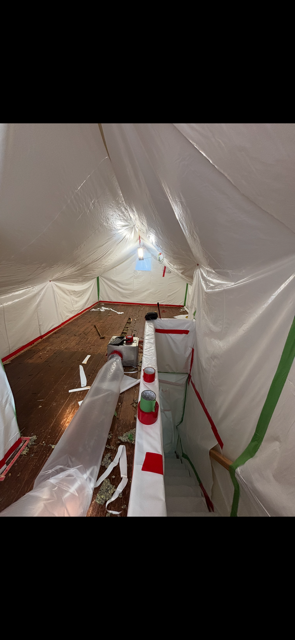
Step 5: If abatement is required, hire a PA-certified abatement contractor. In Pennsylvania, asbestos abatement work above the applicable thresholds requires a licensed contractor, prior notification to the Pennsylvania Department of Labor & Industry, proper containment, and post-abatement air clearance testing before occupants return.
What About the EPA’s Removal Guidelines?
The EPA provides guidance for homeowners on asbestos work in their own homes — this guidance covers keeping materials wet during handling, minimizing disturbance, wearing appropriate respiratory protection, and disposing of asbestos waste at a licensed facility. Pennsylvania homeowners doing work in their own single-family homes are not subject to PA DEP notification requirements under the NESHAP private residence exemption.
However, the exemption does not mean the work is safe to do without proper precautions. At minimum, correct work requires a half-face respirator with P100 filters, disposable Tyvek coveralls, plastic containment, HEPA vacuuming, and labeled sealed disposal bags. Asbestos-containing materials cannot be disposed of in regular household trash in Pennsylvania — they must go to a PA DEP-permitted hazardous waste disposal facility.
For most homeowners, the safer and more practical choice is a licensed abatement contractor, particularly when quantities are above a small amount or when the material is friable.
ACI-TECH, INC. provides licensed asbestos inspection and abatement services in Chester, Delaware County, and the Philadelphia area. Call (610) 497-7162 for a free estimate before your next renovation.