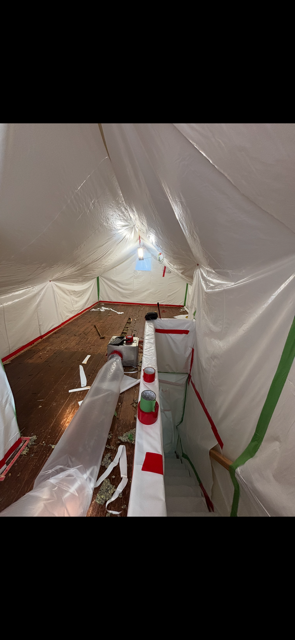
Asbestos is present in the overwhelming majority of Chester’s older housing stock, because the city’s brick row homes were built during the decades when asbestos was a standard component of virtually every material requiring insulation or fire resistance. This isn’t a statistical edge case — Chester has one of the oldest residential housing stocks in Delaware County, and in homes built before 1940, asbestos-containing materials are the rule, not the exception.
Why Chester’s Housing Age Matters
Chester is one of the oldest cities in Pennsylvania, chartered in 1682. Its residential neighborhoods — the dense blocks of brick row homes and twins running from Edgmont Avenue toward the waterfront — were developed primarily between 1900 and 1940. The U.S. Census documents the city’s housing stock as predominantly pre-1950, with the vast majority of units predating 1940.
The relevance to asbestos is direct. The EPA documents that asbestos was introduced broadly into residential construction between the 1930s and 1970s, peaking in the postwar period. A home built in Chester in 1920 would have been renovated multiple times during this peak era — and each renovation layer added materials. The 1920s original may have asbestos pipe insulation. The 1952 kitchen renovation added 9×9 vinyl floor tiles. The 1960s bathroom update brought asbestos-containing joint compound. One house, three exposure points from three different decades.
The Materials Most Likely Present in Chester Row Homes
Understanding which materials correspond to which era helps a homeowner know where to focus attention before any renovation.
Steam pipe and boiler insulation (1900–1940 construction)
Steam heat was the standard in Chester’s row homes built before 1940, and steam systems require insulation on every pipe and on the boiler itself. That insulation, in the era when these homes were built, was asbestos. It typically appears as gray or white wrap on supply lines, corrugated sections at elbows and fittings, and a wrapped jacket around the boiler. In a 1920s Chester row home that hasn’t had its basement pipes disturbed, original asbestos insulation is likely still in place. This is the highest-probability asbestos location in pre-1940 Chester homes.
9×9 vinyl floor tiles and black mastic adhesive (mid-century renovations)
Chester’s older row homes didn’t originally have vinyl floor tile — that came with the mid-century renovation wave. Tiles manufactured roughly from the late 1940s through the early 1970s commonly contained chrysotile asbestos at concentrations of 15–25%. The 9×9 inch size is the clearest visual marker: if your kitchen or basement has 9×9 tiles, they require testing before any floor work. The black adhesive mastic beneath the tiles also commonly contained asbestos, and it’s often more friable than the tiles themselves.
Transite siding and roofing
Asbestos-cement products — sold under the trade name Transite and others — were widely used on exterior siding and flat-roof underlayment from the 1930s through the 1970s. Chester’s row homes with textured or corrugated exterior siding panels, or homes with multi-layer flat roofs, may have transite products. When intact, transite is a relatively low risk because it’s non-friable. When cut, drilled, or broken during renovation, it releases fibers.
Textured ceiling plaster
Many Chester homes received textured ceiling finishes during mid-century updates. Asbestos was used in decorative plaster aggregates and spray-applied ceiling textures through the 1970s. Before any ceiling work — scraping, resurfacing, or removal — the material should be sampled.
The Sun Shipbuilding Connection
Chester’s industrial history adds a secondary layer to the picture. Sun Shipbuilding & Drydock Company, which operated along the Delaware River from 1917 to 1989, employed tens of thousands of workers at its peak — many of whom lived in the surrounding row home neighborhoods. Workers carried asbestos fibers home on their clothing, a documented phenomenon called secondary or take-home exposure that affected family members who laundered work clothes or were present when workers returned from the yard.
This secondary exposure affects people, not building materials — it’s a medical history question, not a renovation testing question. But it’s part of the broader asbestos story in Chester’s residential neighborhoods. For more detail, see our post on Chester’s Sun Shipbuilding asbestos legacy.
What PA Law Requires Before Renovation
Pennsylvania law does not require a homeowner to test a property they own and occupy before renovating — but it does regulate what contractors can do. Under Pennsylvania L&I regulations implementing the Asbestos Occupations Accreditation and Certification Act (Acts 194 and 161), licensed asbestos abatement contractors must provide 5-day prior notification to PA L&I before beginning any friable asbestos project above 3 linear or 3 square feet. Projects above federal NESHAP thresholds — 260 linear feet, 160 square feet, or 35 cubic feet — require 10 working days advance notice to PA DEP.
In practice, this means any licensed contractor performing work on a pre-1980 Chester home will need to know what materials are present before starting. A pre-renovation inspection protects the homeowner from unknowingly triggering these requirements mid-project — and from an unlicensed crew disturbing asbestos without the required procedures.
The Row Home Shared-Wall Factor
Chester’s row home density creates a consideration that doesn’t apply to detached housing: the party wall. If your steam pipes run along a shared wall — or if renovation disturbs materials that connect structurally to the adjoining unit — disturbance in your home can affect a neighbor’s air quality. This is especially relevant for basement pipe work, where supply lines often run horizontally along party walls before rising to upper floors.
This doesn’t change the testing process, but it does mean that the planning for any significant renovation in a Chester row home should account for what’s on the other side of the wall.
Financial Assistance for Chester Homeowners
Delaware County’s Lead Hazard Control Program provides financial assistance to qualifying low-income homeowners who have a child aged 5 or under. While focused on lead, the program covers window and door replacement and related work — services that often intersect with asbestos abatement needs in the same pre-1940 housing stock. Contact the Delaware County Health Department to determine eligibility.
The Practical Step Before Any Renovation
The most common way Chester homeowners are exposed to asbestos fibers is not because the materials are present — it’s because the materials are disturbed without knowing what they are. Floor tile removal, pipe replacement, kitchen renovation, and basement finishing are the routine activities that generate accidental exposure.
Before any of those projects in a Chester home built before 1980, the correct first step is a pre-renovation inspection by a PA-licensed asbestos inspector. The inspection samples suspect materials, sends them to an accredited lab, and produces a report that tells you exactly what you’re dealing with — and what options you have.
ACI-TECH, INC. is based at 2300 W. 4th Street in Chester. We work in Chester’s row homes every week. Schedule an asbestos inspection or call (610) 497-7162 for a free estimate. If the inspection confirms asbestos, we handle asbestos abatement and asbestos removal as well. For a complete overview of asbestos and lead paint risks in Chester — including the Sun Shipbuilding legacy, local steam heat systems, and lead paint data — see our Chester, PA asbestos and lead remediation guide. Available Monday through Saturday, 7 AM to 9 PM.
Sources