Asbestos in contaminated sites, demolition projects, and older buildings is regulated through overlapping federal and Pennsylvania state frameworks. Understanding which rules apply — and who enforces them — matters both for property owners planning work and for anyone trying to understand why certain remediation projects take the shape they do.
The EPA’s Superfund Program (CERCLA)
The EPA’s Superfund program — formally the Comprehensive Environmental Response, Compensation, and Liability Act (CERCLA) — addresses contaminated sites where hazardous substances, including asbestos, have been released into the environment through industrial operations or improper disposal.
When asbestos contamination is identified at a site — typically a former manufacturing facility, mine tailings site, or location of improper dumping — the EPA evaluates the extent and nature of contamination. The agency may take enforcement action requiring cleanup under CERCLA authority. The EPA’s guidance for asbestos-contaminated soil notes that soil containing less than 1% asbestos can still pose health risks depending on fiber type, physical form, and site conditions. The threshold for regulatory action is not simply a percentage number but a risk-based assessment considering likely exposure pathways at the specific site.
Superfund sites with asbestos contamination require cleanup to levels that protect current and reasonably anticipated future land uses. This can include excavation of contaminated soil, capping, institutional controls (deed restrictions on land use), and long-term monitoring.
NESHAP: The Air Emission Standard for Asbestos
Most routine demolition and renovation projects — as opposed to Superfund sites — are governed by the National Emission Standards for Hazardous Air Pollutants (NESHAP) under Section 112 of the Clean Air Act (40 CFR Part 61, Subpart M). This standard controls asbestos emissions to the outdoor air from demolition and renovation of buildings.
Key NESHAP requirements for demolition and renovation:
- Pre-project inspection: An owner or operator must thoroughly inspect a facility for regulated asbestos-containing material (RACM) before demolition or renovation begins.
- Prior notification: Written notice must be provided to the applicable regulatory agency (in Pennsylvania, PA DEP for most projects) before work begins — 10 working days in advance for standard projects.
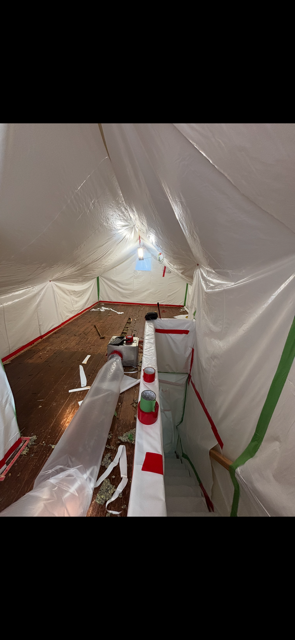
- Emission controls during removal: RACM must be kept adequately wet, properly contained, and handled in a way that prevents visible emissions to outside air.
- Proper disposal: RACM must be disposed of at an EPA-approved waste disposal site. It must be adequately wetted and sealed in containers or wrapping.
In Pennsylvania, the NESHAP notification thresholds for commercial and public buildings are:
- More than 260 linear feet of pipe insulation
- More than 160 square feet of other RACM (floor tiles, ceiling tiles, roofing, etc.)
- More than 35 cubic feet where measurement by feet is not practical
For residential buildings of four or fewer units, special notification requirements apply primarily for intentional demolitions.
Pennsylvania’s Additional Requirements
Pennsylvania enforces NESHAP through the PA Department of Environmental Protection (PA DEP), with the Southeast Region office covering Delaware County, Philadelphia, and surrounding counties.
In addition to federal NESHAP, the Pennsylvania Department of Labor & Industry enforces the Pennsylvania Asbestos Occupations Accreditation and Certification Act (Acts 194 and 161), which governs who is permitted to perform asbestos work. Contractors must hold appropriate PA L&I certifications: separate certifications exist for asbestos inspector, abatement worker, supervisor, contractor, project designer, and management planner. L&I also requires prior notification for contractor-performed projects disturbing more than 3 linear or square feet of friable asbestos-containing material.
These two regulatory tracks — federal air emission standards (enforced by PA DEP) and contractor certification requirements (enforced by PA L&I) — apply simultaneously to most commercial asbestos abatement projects in Pennsylvania. A licensed abatement contractor handles both notification requirements as part of standard project management.
What This Means for Property Owners
If you own or manage a pre-1980 commercial property in Delaware County or the Philadelphia area and are planning demolition, renovation, or sale, a pre-project asbestos survey by a PA-certified inspector is the starting point. The inspector’s report documents what materials are present, in what quantities, and what regulatory notifications and abatement procedures are required before any work can begin.
ACI-TECH, INC. is a PA-certified asbestos contractor serving Chester, Delaware County, and the Philadelphia area. We handle required notifications to PA DEP and L&I as part of every project and begin with licensed asbestos inspection and testing to document what is present. Call (610) 497-7162 for a free estimate.